
Gastbeitrag von Nida Banou

Rise Iran & Javid Shah | anti-postkoloniale Ideologie & anti-Islamismus | Eure Freiheit ist heilig. Beschützt sie.
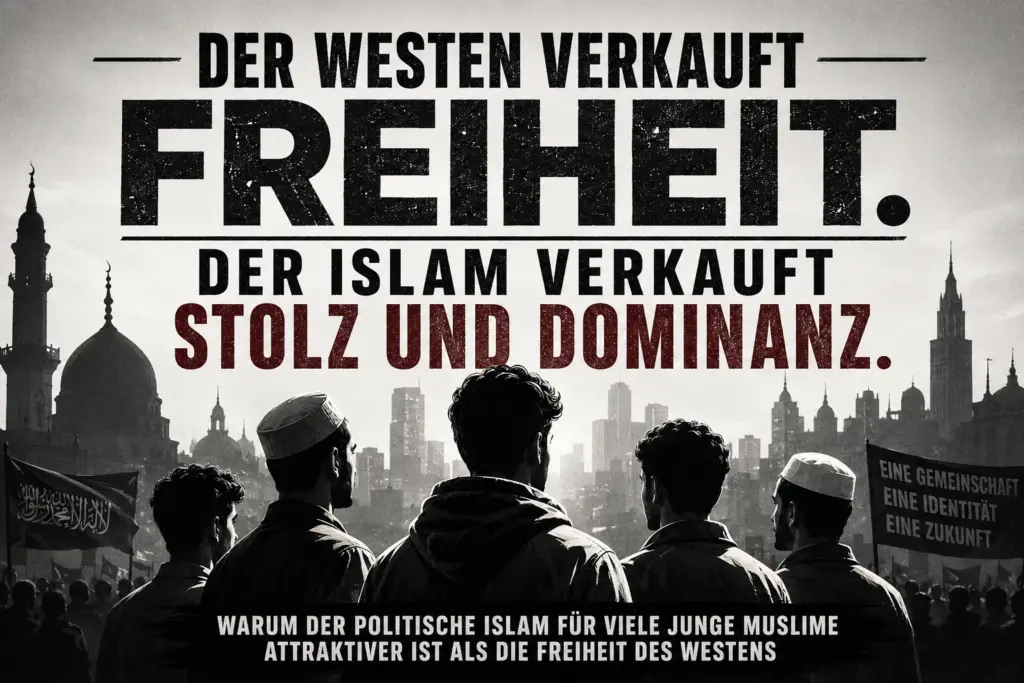
Why are Islamic laws more attractive to many young Muslims than the freedom of the West? Please read on, because I am writing about what many people of German heritage may not dare to say.
When classical sharia becomes state law, it is not only about prayer, fasting or personal piety. It creates a legal order in which men and women are not treated as equal legal subjects in key areas.

Passende X-Beiträge
Aus dem SCHLAGSEITE X-Archiv

In the familiar inheritance arrangement, the son receives twice as much as the daughter. Under Quranic rules, two women take the place of one male witness. Traditionally, a man has more far-reaching unilateral divorce options, may marry several women and occupies a superior legal position within the family.
In most Islamic-influenced legal systems, the following still exist today: male guardianship, unequal divorce rights and the possibility of marrying off underage girls.
Classical Islamic criminal law is also harsh. It may provide for flogging, amputation of a hand and, in the event of repetition, further limbs, as well as the death penalty. Such punishments are not merely a medieval memory; they are still carried out in individual states today.
We must therefore be allowed to say again: It is not people or ethnic groups that are superior to one another. But an order in which women and men have the same rights, a person may leave their religion and the state does not amputate body parts is morally superior to an order, that legitimizes inequality and cruelty as God’s will.
All the more astonishing, then, is the question: Why does political Islam nevertheless remain attractive?
According to current MOTRA data, among Muslims aged 18 to under 40, 33.6 percent were latently and 11.5 percent manifestly sympathetic to Islamism — 45.1 percent combined. Specifically, in the total Muslim sample, 23.8 percent, among others, considered an Islamic theocracy the best form of government, 25.1 percent considered the rules of the Quran more important than German laws, and 44.3 percent considered Islam the only solution to the problems of our time.
That is too significant to dismiss as merely a marginal phenomenon.
This is precisely where political Islam is “strong.” It does not initially advertise amputated hands, disenfranchised women or religious coercion. It sells brotherhood, pride, resistance, purity and the feeling of being part of a great community willed by Allah.
It offers a comprehensive order of meaning: Your life is not random, your role is defined, your community has a history, enemies, heroes and a future. The promise comes first, submission later.
For young men in particular, this offers a powerful identity: You belong. You are needed. You defend your family, your God and your community. You are part of a struggle of world-historical significance. Status is created through strength, loyalty and dominance.
And what does the West offer as an emotional counterproposal?
Too often, merely consumption, individualism and self-optimization — and a culture that criticizes itself with an almost ritualized harshness.
Self-criticism is necessary. Every enlightened society must know its crimes, name its mistakes and learn from its history. But at some point, self-criticism turns into self-denigration and self-castration.
When a society conveys to its own children almost exclusively what they should be ashamed of, when its history is told predominantly as a succession of guilt, oppression and failure, and every positive identification immediately arouses suspicion, no moral strength emerges. Cultural insecurity and a weak identity emerge, which in the worst case may even seek connection elsewhere — for example, in the Islamic world.

And a society that constantly belittles itself does not appear particularly convincing to people seeking pride, strength and belonging and socialized according to these patterns. How are young people supposed to develop respect for an order whose own representatives constantly explain how problematic, privileged, guilty or morally questionable their own culture is?
How is an immigrant supposed to experience this society as something desirable when it itself barely has the courage to say:
This positive narrative is precisely what is missing
Islam says: Be proud of your God and your community. Your history is great. Your faith is true. Your future belongs to you.
The West says: Question yourself. Put yourself into perspective. Apologize.
A free society cannot remain attractive in the long term if freedom is understood only as the absence of constraints.
Freedom also needs meaning. It needs an idea of what it should be used for: science, art, a happy family, responsibility, knowledge, beauty, culture, the common good, achievement, protecting the weak and passing on a civilization to the next generation.
The answer therefore cannot be to become more authoritarian or patriarchal ourselves. Rather, we must civilize honor. In a free society, honor does not mean controlling one’s sister’s sexuality or responding to insults with violence.
It means keeping one’s word, having principles, taking responsibility, protecting the weaker, showing self-control and standing up for one’s family and community.
This includes a patriotism based not on ancestry but on belonging and responsibility.
Europe, and Germany in particular, should once again be proud of its Jewish-Christian, Greco-Roman and Enlightenment heritage: of the rule of law, freedom of conscience, science, equality, human rights and the limitation of religious power.
The fact that freedom, community and patriotism need not be opposites is demonstrated particularly by Iranian culture.
It is strongly shaped by family, hospitality, emotional warmth and community, while also being characterized by a pronounced desire for freedom and an almost limitless pride in its own history, language and civilization.
One can be deeply rooted, seek connection and love one’s country without thereby subordinating the individual to a religion or a collective.
That is precisely where an important alternative lies. Political Islam understands that people need more than comfort.
Our answer must therefore not be less liberalism, but a more self-confident liberalism with patriotism, clear boundaries and an idea of meaning, that goes beyond consumption and individualism.

A free society must once again be able to say:
Because prosperity alone cannot win a struggle over identity. Freedom only wins when people do not merely benefit from it, but can be proud to belong to it.
And what does that mean in concrete terms?
That we must stop confusing strength with aggression and weakness with morality.
When German politicians reflexively and without any consequences call for restraint, negotiate with the Islamic Republic or treat Islamist and jihadist actors like ordinary partners, as if they stood on the same civilizational foundation, we send a fatal signal:
Apparently, our own values are negotiable.
When billions simultaneously flow to Jolani while minorities such as Druze, Kurds or Christians in Syria continue to be threatened or persecuted, we lose more than credibility. We lose respect.
Those who come from cultures in which honor, authority and loyalty are central do not automatically interpret this attitude as humanity. They interpret it as weakness, a lack of principles and betrayal of one’s own people. And they are not entirely wrong about that.
And that is precisely when we become unattractive.
Strength does not mean never negotiating. Strength means still knowing who you are — and what is never negotiable — when negotiating.
📑 Source references for the guest article
The following source references are intended to ensure the transparent traceability of individual statements mentioned in the guest article. The article was published with the author’s permission and was not editorially altered in terms of content.
▶️ Original article by Nida Banou:
The West Sells Freedom. Islam Sells Pride and Dominance.
Original publication of the guest article on X.
▶️ MOTRA – Monitoring System and Transfer Platform for Radicalization:
Phenomenon monitoring – People in Germany 2021 to 2025
Source for the percentages mentioned in the guest article concerning attitudes sympathetic to Islamism among Muslim respondents.
🔎 Spotted an error, criticism or addition?
SCHLAGSEITE.eu stands for careful research and transparent corrections. Have you discovered a factual error, an unclear formulation or a broken link? Then send me your note. If possible, please provide a verifiable source.