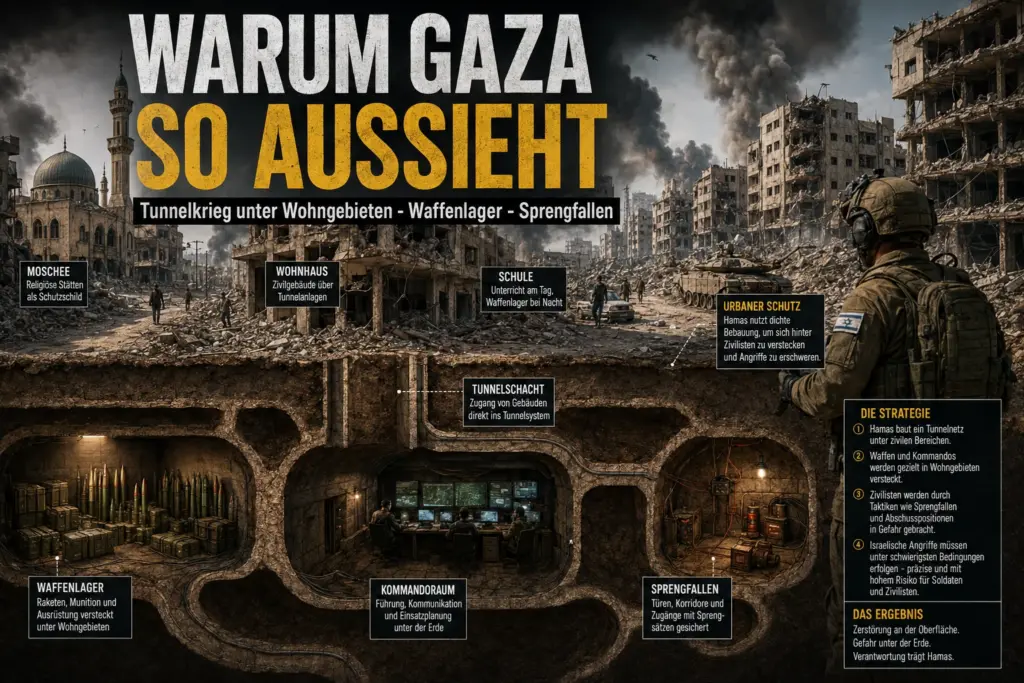


Gaza tunnel warfare: The images from the Gaza Strip show devastation that must neither be downplayed nor stripped of its military context. Entire city districts were destroyed, more than 370,000 housing units were damaged or destroyed, and civilian infrastructure was affected on an almost unimaginable scale. Yet the sight of the ruins alone reveals neither the cause of every instance of destruction nor the nature of the fighting that preceded it.
Anyone who wants to understand why Gaza looks the way it does today must therefore look beyond the visible rubble. Hamas waged its war from within a densely populated civilian environment, linking tunnels, residential areas, public buildings and entire streets to its military system. This underground and above-ground interconnection is one of the decisive factors when explaining the extent of the destruction.
The Visible Destruction and the Invisible War
Satellite images make the situation appear clear: roofs are missing, residential blocks have collapsed, and streets have disappeared beneath the rubble. The United Nations Satellite Centre UNOSAT documented damage to a large portion of the mapped built-up area by October 2025.
Such images are often immediately used to support the claim that Israel destroyed Gaza indiscriminately or out of revenge. Yet a damage assessment initially shows only that a building was damaged or destroyed. It does not show what was previously located there, whether fighting took place in or beneath the building, whether weapons or explosive traps were present, whether a tunnel ran through it, or what the military situation was at the time of its destruction.
The causes of the damage are correspondingly diverse. They include airstrikes, artillery and tank fire, urban combat, controlled demolitions, bulldozer operations, exploding ammunition depots, booby traps and the destruction of underground facilities.


Passende X-Beiträge
Aus dem SCHLAGSEITE X-ArchivThe Tunnel System as a Defining Element of the War
Hamas’s underground network is not a marginal phenomenon. An analysis published in September 2025 by the U.S. Army’s Center for Army Lessons Learned describes the tunnel system as a defining feature of the war.
Citing published reports, the analysis gives an estimated total length of 350 to 450 miles, or approximately 560 to 725 kilometers, as well as around 5,700 shafts. These figures are estimates from published reports and do not constitute a complete survey of the entire tunnel network. Their scale alone shows, however, that this was not a matter of a few isolated shelters or connecting passageways.
The tunnels performed central military functions. They fulfilled roles for which a conventional army on the surface would need roads, barracks, warehouses, supply routes and command posts. Fighters could be moved through them, weapons transported, rocket attacks prepared, ambushes organized and already-cleared areas infiltrated again. According to the U.S. Army analysis, deeper facilities contained command posts, sleeping quarters and storage areas.
Their connection to the built environment is crucial. Tunnel entrances could be concealed in or next to buildings. This made surface combat and underground warfare practically inseparable. The U.S. Army expressly notes that this interconnection made the tunnels more difficult to combat and that neutralizing them in densely built areas could have significant effects on buildings and infrastructure.
The following video illustrates the connection between the buildings on the surface and the underground infrastructure and thereby highlights a central problem of this war.
A Civilian Environment as a Military System
Hamas did not fight from a segregated military area. Weapons, shafts, command facilities, booby traps and escape routes were repeatedly found, according to Israeli documentation, in residential areas and in the immediate vicinity of civilian facilities.
The IDF describes the military use of civilian areas as a central component of Hamas’s strategy. This pattern is consistent with the findings on the extensive tunnel system and with military analyses of underground warfare.
In April 2025, for example, the IDF reported finding weapons in Rafah in bags marked with UNRWA insignia. The site was reportedly located about 80 meters from a building formerly used as a school and about 100 meters from a former hospital. Several houses fitted with booby traps were also neutralized during the same operation.
The corresponding IDF operational report contains visual material and specific information about the locations where the items were found. It illustrates the dangers Israeli troops faced in densely built areas.
ℹ️ What the U.S. Army Derives from Gaza
The U.S. Army does not assess underground combat as a separate specialized task. Rather, its analysis concludes that fighting above and below ground was closely connected. Troops had to secure buildings, streets and tunnels simultaneously, while Hamas fighters could use underground routes for movement, resupply, ambushes and renewed infiltration.
Military Use and Human Shields
The military use of civilian spaces and the legal term human shields are not entirely identical. For conduct to be legally classified as the use of human shields, the presence or movement of civilians must be intentionally used to protect military objectives or operations.
This conceptual distinction does not alter the fundamental problem posed by Hamas’s strategy. Anyone who integrates tunnels, weapons depots, firing positions or military access points into densely populated civilian spaces directly connects its own military system with the civilian population’s surroundings.
This considerably increases the risks to civilians. At the same time, it makes it significantly more difficult for the opponent to distinguish between civilian infrastructure and military objectives.
The term “human shields” should therefore be used where the intentional use of civilians required for that classification can be substantiated. The embedding of military activity in civilian areas remains, independently of this, a central factor in understanding the war in Gaza.
When a Residential Building Can Become a Military Objective
International humanitarian law distinguishes between civilian objects and military objectives. Residential buildings, schools, medical facilities and places of worship are generally civilian objects.
The International Committee of the Red Cross states as a basic rule that parties to a conflict must distinguish between civilian objects and military objectives.
However, a civilian building can lose its protection from direct attack if it is actually being used for military purposes. This may be the case, for example, when a building serves as a firing position, weapons depot, command facility or access point to a military tunnel and its neutralization offers a concrete military advantage.
This definition arises from Article 52 of Additional Protocol I to the Geneva Conventions.

Where there is doubt as to whether a building ordinarily used for civilian purposes is actually being used militarily, it must generally be presumed to retain its civilian use. The decisive factor is therefore not the building’s original appearance but its actual function in the specific military situation.
A residential building does not automatically remain an exclusively civilian object regardless of its actual use. If it becomes part of military operations, its legal assessment changes.
Attacks remain subject to the principles of distinction, proportionality and precaution. The International Committee of the Red Cross explains these principles as central rules of warfare.
The legal framework is therefore clear: What matters is the object’s specific use, the military advantage and the information available at the time of the operation. A satellite image of the later ruin cannot reconstruct these factors.
Why Armies Deliberately Demolish Buildings
Controlled demolitions serve specific military functions in urban and tunnel warfare. They can bury tunnel entrances, collapse underground spaces, eliminate booby traps, destroy weapons depots or prevent a building that has already been cleared from being used again as a firing position.
For soldiers, a demolition can also be considerably safer than moving through a building room by room again. In a booby-trapped building, every door, staircase or wall can become a trap. A seemingly secured house can be re-entered through a tunnel. A basement can serve as an access point for an ambush, while shooters in neighboring buildings monitor a street.
The Modern War Institute described the combination of dense development, tunnels, ambushes and booby traps as one of the greatest challenges facing Israeli ground forces even before the beginning of the major ground offensive.
Against this background, the controlled destruction of dangerous structures is not an inexplicable practice or one unique to Israel, but part of the military logic of fighting fortified, booby-trapped and interconnected underground positions.
The following video shows controlled demolitions carried out during Israeli ground operations and illustrates this method.
Booby Traps and the Fight for Areas Already Cleared
The urban fighting in Gaza did not proceed linearly. Areas were captured, abandoned and later entered again. Hamas fighters could use tunnels to emerge behind Israeli lines or return to areas that had previously been cleared.
As a result, a building that had already been searched or secured could later be used again as a position, weapons depot or trap.
The IDF repeatedly reported mined houses and hidden weapons depots. This corresponds to the tactical utility of the tunnel system, which the U.S. Army also describes: Hamas could move underground, prepare attacks, withdraw and reappear elsewhere.
For Israeli soldiers, this meant that a single inspection of a building was not necessarily sufficient. Dangerous structures had to be monitored, searched again or rendered permanently unusable.
The destruction of such buildings therefore cannot be seriously considered without taking into account the tactical context of tunnels, booby traps, ambushes and renewed infiltration.
When the Destruction of Tunnels Reaches the Surface
Underground facilities cannot be destroyed without affecting the ground above them. The damage caused depends on depth, construction method, soil conditions, method used, and distance from surrounding buildings.
The U.S. Army analysis names various methods for neutralizing tunnels, including mechanical collapse, controlled explosive charges, blocking materials, and specialized munitions.
Especially in densely built-up areas, such measures cannot remain isolated underground. When a tunnel collapses, foundations can subside, roads can be damaged, or adjacent buildings can be affected.
This does not mean that every damaged building stood above a tunnel. But neither does it mean that tunnel warfare is irrelevant to the visible damage pattern.
Anyone assessing Gaza’s surface without taking the military infrastructure beneath it into account is, literally, looking at only half the battlefield.
The following video shows the targeting of underground infrastructure and illustrates why measures taken beneath the ground can have consequences for buildings and roads at the surface.
Urban Warfare Has No Clean Line of Separation
In densely built-up areas, buildings themselves become tactical factors. They provide cover and concealment, restrict routes of movement, enable ambushes, and can be connected to one another through breaches in walls or tunnels.
Vehicles tear down walls to bypass narrow or mined streets. Shelling can trigger secondary explosions when ammunition or fuel is located inside a building. The collapse of one house can damage neighboring structures.
Comparable Patterns of Destruction also emerged in Mosul and Raqqa during the fight against the so-called Islamic State.
This is crucial to the assessment. Massive destruction is not an Israeli phenomenon unique to Israel. It is among the known consequences of modern urban warfare when a militarily inferior organization fights from within a densely built-up city, integrates positions into the built environment, and uses underground infrastructure.
The Modern War Institute therefore classified Gaza early on as a particularly difficult example of modern urban warfare.
Gaza also has additional distinctive features. The population density, the spatial confinement, the number of displaced people, the long duration of the war, and above all the extraordinary extent of the tunnel system significantly intensified the conditions of this battlefield.
The Scale of the Devastation
The scale of the damage is enormous. The United Nations Satellite Centre, UNOSAT, concluded, based on imagery from October 11, 2025, that approximately 81 percent of all mapped structures in the Gaza Strip were damaged.
UNOSAT identified 123,464 destroyed, 17,116 severely damaged, 33,857 moderately damaged, and 23,836 potentially damaged structures. A total of 198,273 affected buildings were recorded. The assessment was based on satellite imagery and, at that time, had not yet been confirmed by comprehensive on-the-ground investigations.
The joint damage and needs assessment by the European Union, the United Nations, and the World Bank dated April 20, 2026, puts direct physical damage at 35.2 billion U.S. dollars.
In addition, estimated economic and social losses amount to 22.7 billion dollars. Reconstruction and recovery over ten years are estimated to require approximately 71.4 billion dollars. The assessment also counts more than 371,000 damaged or destroyed housing units.
⚠️ Destruction Is Not Automatic Legal Evidence
Satellite imagery and damage statistics document the scale of the devastation. However, they do not automatically document its military cause or the specific combat situation. Anyone who immediately infers indiscriminate attacks, revenge, or a particular intent from the number of destroyed buildings is reading information into the images that they themselves do not contain.
October 7 and Hamas’s Responsibility
The starting point of this war must not disappear from the analysis of the destruction. On October 7, 2023, Hamas and other Palestinian terrorist organizations attacked Israeli towns and military bases.
The United Nations Commission of Inquiry found that civilians were deliberately attacked and killed, people were mistreated, and hostages were abducted to the Gaza Strip. The commission assessed deliberate killings, hostage-taking, and other acts as war crimes.
Israel responded with the stated aim of destroying Hamas’s military capabilities and eliminating the threat it had created.
By that point, Hamas had already spent years embedding its military infrastructure deep within Gaza’s civilian environment. The extensive tunnel system connected residential areas, roads, and other above-ground structures to an underground military network.
Thus, Hamas played a significant role in determining the conditions under which this war had to be fought.
Anyone who removes Hamas from the explanation of today’s destruction presents the result of a war while ignoring a decisive part of its military cause.
Why the Revenge Narrative Does Not Hold Up
The claim that Gaza was destroyed out of Israeli revenge does not explain the military reality. It ignores tunnels, booby traps, weapons depots, fallback routes, ambushes, underground supply routes, and the deliberate relocation of military structures into densely built-up areas.
It also ignores that Israeli troops were not only fighting combatants on the surface, but an extensive multilevel underground network that enabled Hamas to evade direct combat and launch renewed attacks from areas that had already been cleared.
The visible ruins are therefore not self-explanatory evidence of Israel’s motives.
Satellite imagery can show which building is no longer standing today. But it cannot show what was inside or beneath it at the time of the fighting, what threat existed there, whether a tunnel entrance was present, whether the building was booby-trapped, or what information was available to the troops involved.
This exact military history often disappears when images of destroyed homes are circulated without further context.
Gaza Was Turned into a Battlefield
Gaza is not in ruins because its buildings were meaningless to Israel. It is in ruins because an exceptionally intense war was fought in, between, and beneath these buildings.
Hamas made the civilian environment part of its military system. Tunnels ran beneath built-up areas, shafts connected the surface and the underground, buildings could conceal weapons, positions, or entrances, and areas that had already been cleared could be infiltrated again.
Israel therefore had to fight an adversary whose military infrastructure was precisely not cleanly separated from the civilian environment.
This does not explain every single damaged wall. But it does explain why the overall picture of destruction cannot credibly be presented as mere evidence of Israeli revenge or indiscriminate destruction.
Hamas systematically linked its military infrastructure with Gaza’s civilian buildings. The extensive tunnel system, hidden shafts, weapons depots, booby traps, ambushes, and renewed infiltration of cleared areas made the city itself an essential part of the battlefield.
Anyone seeking to explain the scale of the destruction must therefore consider the war above and below ground together. The ruins show the result. Without Hamas, tunnel warfare, and urban combat, they do not explain how this result came about.
Anyone who shows only the ruins and omits Hamas is not telling the whole story…
ℹ️ Factual basis and primary sources for the article 📑
▶️ Israel Defense Forces:
The War Against Hamas: Answering Your Most Pressing Questions
Documentation on the military use of civilian areas, tunnel facilities, and Israeli operations against Hamas.
▶️ Israel Defense Forces:
Hamas Weapons Located in UNRWA Bags Near Civilian Buildings
Operational report from April 2025 on weapons discoveries and houses rigged with explosives in Rafah, including visual material and information on the locations of the discoveries.
▶️ U.S. Army:
Subterranean Operations: Israeli Defense Force Lessons from Gaza
U.S. Army analysis from September 2025 on the scale, structure, function, and targeting of the Hamas tunnel system.
▶️ Modern War Institute at West Point:
These Are the Challenges Awaiting Israeli Ground Forces in Gaza
Modern War Institute analysis of the particular dangers and tactical problems of ground warfare in the densely built-up Gaza Strip.
▶️ Modern War Institute at West Point:
The Destructive Age of Urban Warfare
Foundational analysis of the high destructive impact of modern combat in cities.
▶️ Modern War Institute at West Point:
Israel, Gaza, and the Looming Challenges of Urban Warfare
Assessment of the military, civilian, and operational challenges of urban warfare in Gaza.
▶️ International Committee of the Red Cross:
Article 52 of Additional Protocol I to the Geneva Conventions
Definition of civilian objects and military objectives, as well as the presumption in cases of doubt for objects normally used for civilian purposes.
▶️ International Committee of the Red Cross:
Customary IHL Rule 7: Distinction Between Civilian Objects and Military Objectives
Fundamental rule of international humanitarian law concerning the distinction between civilian objects and military objectives.
▶️ International Committee of the Red Cross:
Frequently Asked Questions on the Rules of War
Overview of the principles of distinction, proportionality, and precautions.
▶️ International Committee of the Red Cross:
Human Shields
Legal assessment of the prohibition against using the presence or movement of civilians to shield military objectives or operations.
▶️ United Nations:
UN Commission of Inquiry Report on the Attacks of October 7, 2023
Investigation of the deliberate attacks on civilians, hostage-taking, and other crimes committed by Hamas and other armed groups.
▶️ UNOSAT:
Gaza Strip Comprehensive Damage Assessment
Satellite-based damage assessment with data as of October 11, 2025.
▶️ European Union, United Nations, and World Bank:
Gaza Strip Rapid Damage and Needs Assessment
Joint assessment of physical damage, economic losses, and reconstruction needs in the Gaza Strip dated April 20, 2026.
🔎 Found an error, criticism, or addition?
SCHLAGSEITE.eu stands for careful research and transparent corrections. Have you found a factual error, unclear wording, or broken link? Then send me your note. If possible, please provide a verifiable source.