

00:00 / –:–
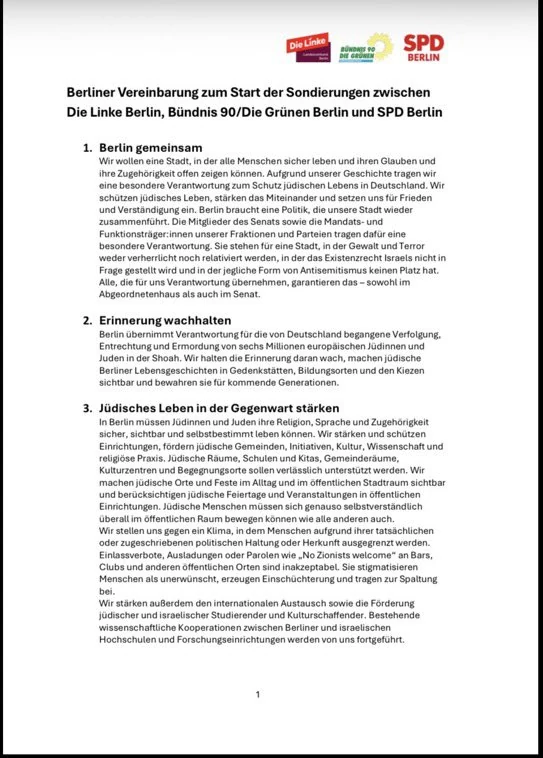
Three scraps of paper—and in the end, they only monitor themselves. The Berlin Left Party, Greens and SPD have written down how firmly committed they are to fighting antisemitism. What is meant is the “Berlin Agreement on the Start of Exploratory Talks” of October 8, 2026. The SPD and Greens had made an agreement on how to deal with antisemitism a prerequisite for exploratory talks following the election to the House of Representatives done. The background was several incidents within Die Linke that had also caused concern among potential coalition partners. The result is three pages full of declarations. And precisely where things could become uncomfortable for their own people, there remains plenty of room for manoeuvre. To me, that is political hypocrisy.
Recognising Israel’s right to exist and condemning the Hamas massacre is no political feat of heroism. There is no applause for that. It must be taken for granted. Anyone who first needs an agreement on this before they can govern together has a problem that can hardly be resolved with three pages of paper.
Understanding on how to deal with antisemitism: parliamentary groups decide for themselves
The procedure for anti-Semitic incidents within their own ranks is particularly revealing. At the request of at least one parliamentary party manager, the three parliamentary party managers of the governing parliamentary groups appoint a panel of three experts. They are to assess the incident professionally. They are appointed by consensus before the coalition agreement is adopted. The prospective coalition partners must therefore first agree on the evaluators.
The decisive sentence reads: “It decides on the consequences on its own responsibility and communicates its decision transparently.” The parliamentary group concerned is meant. How convenient. The experts assess the incident. As for what political consequences this has for their own people, they would rather decide that themselves.
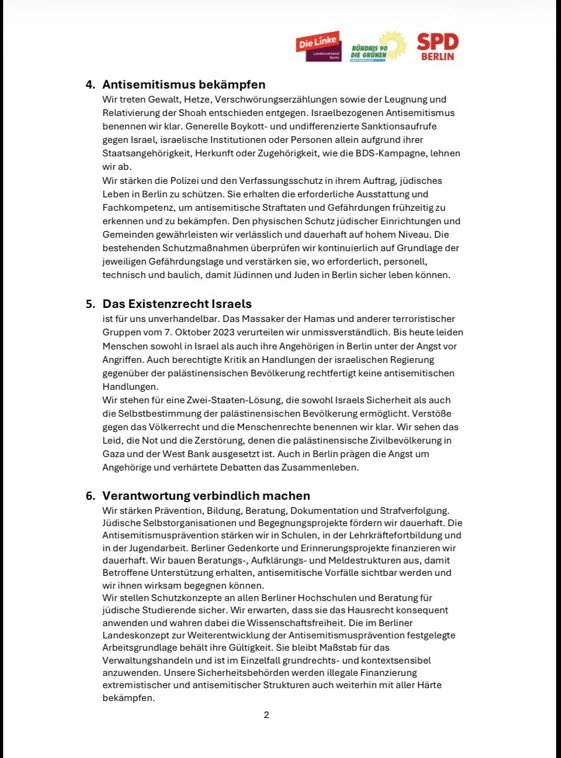
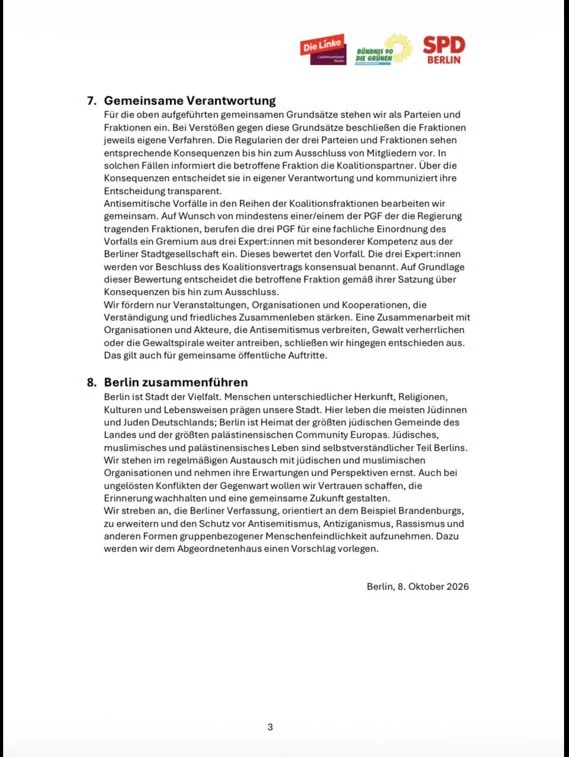
The paper makes it possible to exclude a party from a parliamentary group, but does not require it. It lacks firm deadlines for decisions, binding minimum consequences and a regulated next step in the event that a parliamentary group responds to a clear assessment with a ridiculously mild measure. That is precisely where the grand declaration of commitment becomes a rather convenient affair.
The Greens and the SPD are signing up to this as well. Afterwards, anyone can point to the agreement and explain that they had, after all, taken an unequivocal position. The coalition can continue negotiating. Problem off the table for the time being. At least for the parties.
The standard by which the expert panel is to assess cases is also not explicitly defined. The IHRA working definition is not mentioned by name. Although, with regard to administrative action, the paper refers to the existing working basis of Berlin’s state concept, it does not explicitly stipulate that this basis also determines the panel’s assessments in cases involving parliamentary groups. Thus, the next dispute is already in the making: Which standard applies when it concerns one’s own people?
Resistance from within the Left Party against the antisemitism agreement
How deep the conflict runs is shown by the resistance from within the Left Party. According to a report by t-online and dpa dated October 9 , around 120 members have signed a joint statement against the agreement. They include members of the Bundestag and the Berlin House of Representatives, as well as members from other federal states.
The signatories accuse the paper of adopting “narratives of a media smear campaign.” The SPD and Greens would be bringing “mechanisms of discipline and division” into the party. That is their counterstatement. To me, this reaction shows above all: Even an agreement that leaves the decision on consequences to the parliamentary group itself is already too much for parts of the Left .
Central Council President Josef Schuster also considers the agreement inadequate. Speaking to the RedaktionsNetzwerk Deutschlandhe explained that there had been serious reasons for sanctions within the Left for months. Consequences beyond verbal commitments had failed to materialize. His verdict: “The joint paper cannot replace determined action.”
That is precisely what the SPD and the Greens must be judged by. Anyone who makes an agreement on how to deal with antisemitism a condition for talks must subsequently also make consequences a condition for cooperation. Otherwise, in the end, the signature will be enough to allow the formation of a government to proceed.
Passende X-Beiträge
Aus dem SCHLAGSEITE X-ArchivJewish Berliners need security, not a self-certification
For Jewish Berliners, nothing has been resolved by this at all. They do not need mutual certificates of no objection from three parties. They need security in the streets, at schools and universities. And they need politicians who act even when antisemitism comes from within their own circles.
The scale of the problem is shown by the figures from RIAS BerlinFor 2025, the reporting office documented 2,197 antisemitic incidents. That is an average of around six per day. This also includes incidents that do not meet the threshold for criminal liability. This figure describes documented hatred of Jews, not merely a political mood.
Rejecting BDS and opposing “No Zionists welcome” is right. But then these standards must also apply to one’s own political allies. Anyone who condemns exclusion when practiced by opponents but looks for a lenient explanation when it is practiced by their own coalition partner is not waging a credible fight against antisemitism.
The many promises of protection also remain without concrete amounts of money or implementation deadlines in this paper. More prevention, more counselling, more support. Nicely listed. A verifiable commitment would have to state who will implement which measure, by when, and with what resources. It is precisely this binding commitment that is lacking.
A serious process would require firm deadlines, a clear assessment standard and comprehensible consequences for confirmed violations. In addition, it would require an independent expert assessment and a binding political commitment from the partners not simply to accept treatment without consequences. Anyone who declares antisemitism a red line must also say what happens when their own people cross it.
To me, this three-page document is neither one thing nor the other. It contains enough correct statements to be presented publicly, and enough non-commitment to keep postponing unpleasant decisions.
Whether it is backed by serious resolve will be shown in the treatment of one’s own personnel. In one’s own contacts. At joint appearances. And at the latest when a clear decision puts the planned majority at risk.
Those who turn a blind eye to antisemitism among their own people can spare themselves the fine declarations.
ℹ️ Factual basis and primary sources for the article 📑
▶️ Berlin Agreement, documented by FOCUS online:
The Antisemitism Declaration in Full
Basis for the statements on protection commitments, expert assessment and decisions by the faction concerned.
▶️ t-online and dpa, October 9, 2026:
Around 120 signatories reject Berlin Agreement
Report on the statement from the Left Party, previous incidents and the conditions for the start of the exploratory talks.
▶️ RedaktionsNetzwerk Deutschland, October 8, 2026:
Central Council of Jews says Berlin Agreement does not go far enough
Statements by Central Council President Josef Schuster on the lack of consequences and the limits of the document.
▶️ RIAS Berlin, May 20, 2026:
Statement on the report “Antisemitic Incidents in Berlin in 2025”
2,197 documented antisemitic incidents in 2025.
🔎 Spotted an error, criticism, or addition?
SCHLAGSEITE.eu stands for careful research and transparent corrections. Did you spot a factual error, unclear wording, or broken link? Then send me your tip. Please provide a verifiable source whenever possible.