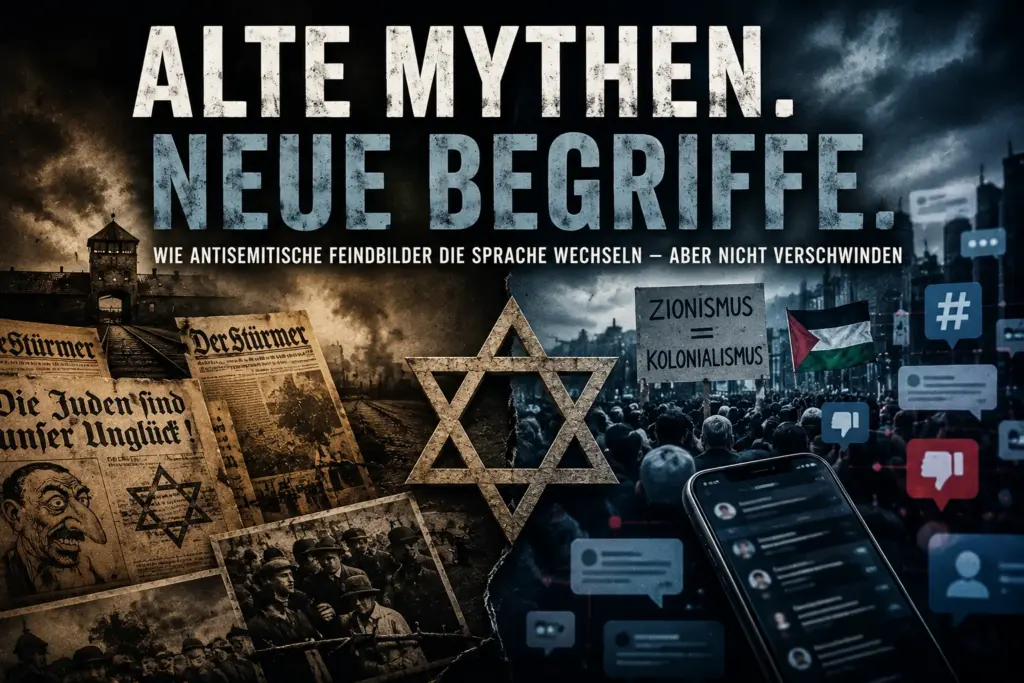

Antisemitism rarely reinvents itself. It changes its language. What was once openly propagated as alleged Jewish control over banks, the press, politics or social developments now often reappears in modernized terms, political code words and supposedly progressive language. The old hatred of Jews has not disappeared. It has learned to adapt to its surroundings.
Federal Minister for Family Affairs Karin Prien warned of precisely this development in an interview with WELT AM SONNTAG . She observed that conspiracy myths that were already widespread in the late 19th century and up to 1933 were returning. Particularly since Hamas’s terrorist attack on Israel on 7 October 2023 , the social climate has changed.
For Prien, this warning also has a personal dimension. She is the first federal minister with Jewish roots. Both grandfathers were Jewish; her family history is marked by persecution and flight during the Nazi era. Prien herself describes how naturally this history was already present in her childhood and how cautiously her family dealt with its Jewish origins for a long time.
Prien thus addresses a point that is easily overlooked: Antisemitic myths and narratives do not have to use the same words to convey the same ideas. The packaging changes. The core remains remarkably stable.

Passende X-Beiträge
Aus dem SCHLAGSEITE X-Archiv
Why antisemitic myths are so remarkably persistent
Antisemitic myths are never merely a collection of individual prejudices. They often function as a comprehensive explanatory framework. Complex social, political or economic developments are attributed to an alleged hidden power. And this power is linked to Jews.
In the 19th and early 20th centuries, this included claims that Jews controlled finance, the press or political decisions. At the same time, they could be blamed for entirely opposing developments, depending on political needs. For some, Jews embodied supposedly ruthless capitalism; for others, they stood behind Bolshevism, revolution and social upheaval.
The contradiction did not matter. Because antisemitism does not follow a consistent political theory. It works through an enemy image that can be adapted almost arbitrarily.
The German Historical Museum describes an aggressive antisemitic propaganda campaign in the Weimar Republic, in which democratic and left-wing politicians alike were defamed as part of an allegedly “Jewified” order. At the same time, conspiracy narratives about Jewish power and influence spread.
A particularly influential example was the so-called “Protocols of the Elders of Zion”. The antisemitic forgery claimed that secret Jewish leaders were planning to control politics, the economy, the media and ultimately the world.
The fact that these purported minutes of meetings were entirely fabricated did not prevent their dissemination. The United States Holocaust Memorial Museum calls the text one of the most influential antisemitic conspiracy narratives in modern history. Editions were already circulating in Germany in the 1920s.

ℹ️ The decisive mechanism
Antisemitic myths explain complex processes through an alleged hidden Jewish power. Economic crises, wars, revolutions, social change or political decisions then no longer appear as the result of many factors, but as part of a secret plan.
The terms change, the pattern of thought remains
Today, hardly anyone openly speaks of an alleged “Jewish world conspiracy,” at least not in social circles that still want to be taken seriously. That does not necessarily mean such ideas disappear. They can live on in code words.
Terms such as “globalists,” “financial elites,” “puppet masters” or the idea of a secret power behind governments and the media can antisemitic myths absorb and perpetuate when they are linked to classic anti-Jewish enemy images. The Federal Agency for Civic Education expressly points out that modern conspiracy narratives can connect to centuries-old antisemitic codes.
A careful distinction is necessary here. Not everyone who talks about political elites, lobbying, banks or international networks is expressing themselves antisemitically. What matters is the underlying pattern. If Jews or people marked as Jewish are portrayed as a cohesive group that allegedly controls the media, the financial world or governments, the historical continuity is difficult to overlook.
That is precisely where antisemitism’s adaptability lies. It does not necessarily need the word “Jew,” as long as the old image remains intact.
What the new language actually sounds like today
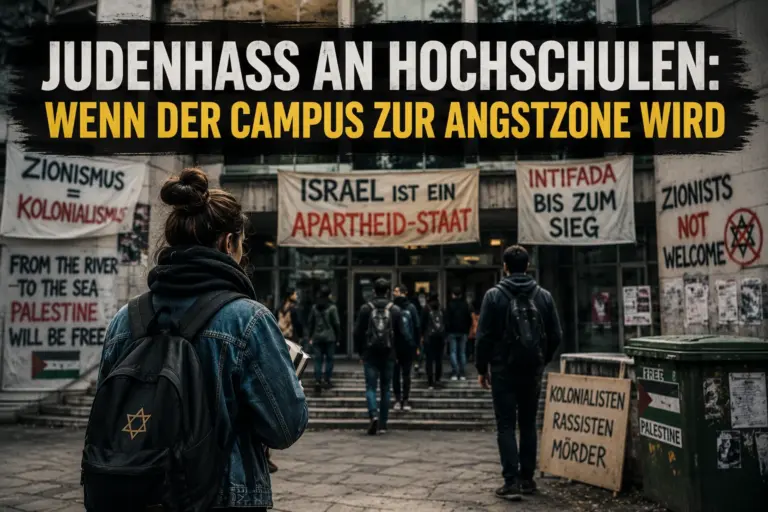
RIAS Saxony documented, among other things, a demonstration in its annual report on antisemitic incidents in 2024 in Leipzig in August 2024. Posters were displayed there equating “Zionists” with fascists . Another sign claimed that the Israeli army kills babies. RIAS explicitly classified this depiction as a modern adaptation of the medieval blood libel.
The example therefore does not stand in isolation as a freely chosen anecdote, but is part of the incident situation documented by RIAS. It shows very concretely how antisemitic myths function in new language. The structure of the old myth can remain intact while the object is exchanged: “the Jews” become Israel or “Zionism,” and ritual murder becomes the sweeping accusation of deliberately murdering children.
The RIAS report for Berlin 2025 also describes the enemy image of “Zionism” as an increasingly present political label. Among other things, it documented coined terms equating Zionism with National Socialism, as well as threats of violence and extermination against people marked as “Zionists.” In such cases, the term has long ceased to denote an objective discussion about a political movement. It functions as an enemy label.
Those who react only when the phrase “the Jews” is used explicitly therefore overlook a considerable part of the forms antisemitism currently takes.
When “the Jews” suddenly become “the Zionists”
This linguistic shift is particularly visible in attitudes toward Israel. The term Zionism initially refers to a real political and historical movement advocating the Jewish people’s national self-determination and the establishment or preservation of a Jewish state. The term itself is, of course, not antisemitic.
It becomes problematic when “Zionist” no longer denotes a political position, but is used as a substitute word for Jews. When alleged “Zionists” are said to control the media, direct governments, start wars or pull the strings behind the scenes worldwide, no new argument has been invented. An old antisemitic enemy image has merely been renamed.
The Federal Association of RIAS determined for 2025 that the enemy image of “Zionism” played a central role in antisemitic incidents. The incidents documented included enemy labeling, calls for violence and physical assaults. In one case in Kassel, a victim was first insulted antisemitically as a “Zionist” and then attacked.
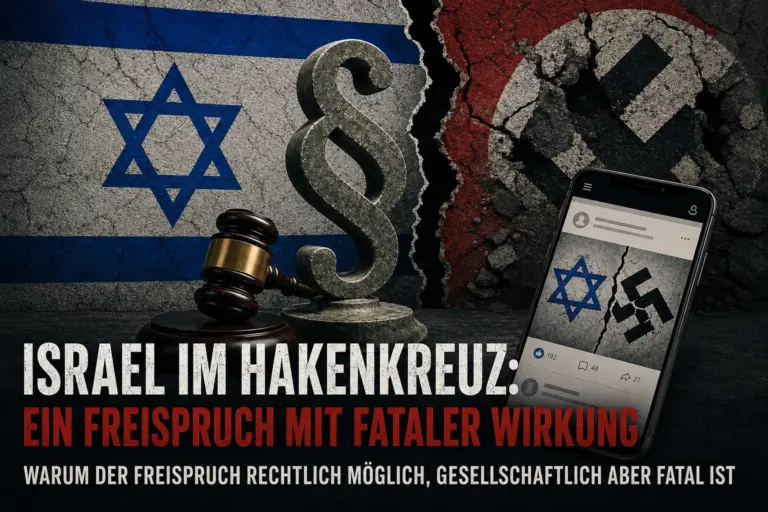
The working definition of the International Holocaust Remembrance Alliance also draws an important boundary here. Criticism of Israel, such as can be expressed toward any other state, is not automatically antisemitic. It can, however, become antisemitic when Jews are collectively held responsible for Israeli policies, a special loyalty to Israel is ascribed to them, or classic antisemitic images are transferred to Israel.
One may criticize Netanyahu. One may criticize Israeli governments. One may criticize military decisions. But a Jew in Berlin, Cologne or Munich is neither a representative of the Israeli government nor responsible for decisions by the Israeli army. Anyone who nevertheless holds that person responsible is not criticizing Israel. They are holding one Jew responsible for the actions of other Jews.

7 October was a catalyst, not the origin
The terrorist attack by Hamas on Israel on 7 October 2023 was not the beginning of antisemitism in Germany. The developments afterward nevertheless show how quickly existing resentments and antisemitic myths can be activated, politically mobilized and spread through digital networks.
According to RIAS, the number of documented antisemitic incidents rose significantly immediately after the massacres. In 2025, 8,725 antisemitic incidents were recorded nationwide, an average of just under 24 per day. Compared with 2022, the figure has therefore more than tripled. In 68 percent of the documented incidents , RIAS identified antisemitism related to Israel.
These included 178 physical attacks, 257 threats and four cases of extreme violence. More than a quarter of the recorded incidents took place online.
These figures are not police statistics. RIAS explicitly documents incidents below the threshold of criminal liability as well. This is important, because otherwise different statistics could be conflated.
The Federal Criminal Police Office , by contrast, recorded 6,548 antisemitic offenses for 2025. That was five percent more than the previous year and another record high. RIAS and the BKA therefore measure different things, but both point to the same fundamental problem: Antisemitism in Germany remains at an exceptionally high level.
The propaganda does not end with the terrorist attack
The increase after 7 October cannot be explained solely by existing resentments becoming visible. Since the massacre, there has also been a struggle over images, terms and interpretations. In the WELT interview, Prien explicitly speaks of a “propaganda offensive” by Hamas, which is having an impact particularly among younger people.
Social media intensify this dynamic and the spread of antisemitic myths. Images, short videos and emotional catchwords spread within seconds, while contextualizing them takes considerably longer. At the same time, RIAS Berlin recorded an increase in statements glorifying terrorism in connection with antisemitic incidents from 161 in 2024 to 245 in 2025.
Terms such as “genocide,” “apartheid” or accusations of the deliberate murder of children also circulate in this environment. The appearance of such terms is not automatically antisemitic. The line is crossed when they are linked to classic antisemitic motives, Israel is equated with National Socialism, Jews are held collectively responsible, or a Jewish or “Zionist” will to exterminate is constructed from the accusation of military action.
The blood libel legend becomes the blanket accusation of “child murder,” the Jewish world conspiracy becomes the alleged global power of “the Zionists,” and the demonic Jew becomes the demonized Jewish state. The terms sound more modern. That does not necessarily mean the underlying pattern of thought is any different.
Antisemitism has several political addresses
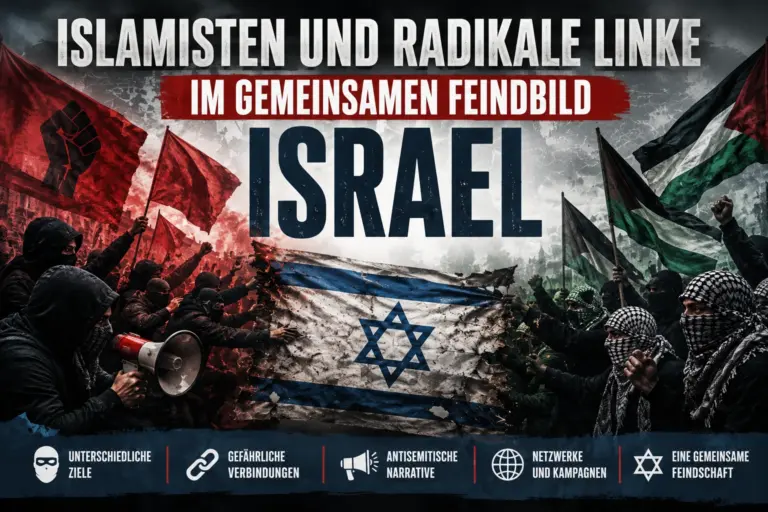
People like to look for hatred of Jews precisely where they themselves do not stand politically. The right points to Islamists and the left; the left points to extremists on the right; Islamist ideologues sell hatred of Israel as political resistance. Antisemitic myths therefore cannot be neatly assigned to a single political camp. Reality is more uncomfortable. And yet the current weighting is clear.
Nationwide, RIAS classified 68 percent of all documented incidents in 2025 as the manifestation of antisemitism related to Israel. This makes it the most frequently documented manifestation at present. At the same time, RIAS recorded 807 antisemitic incidents with a far-right background, the highest figure since nationwide data collection began in 2020.
ℹ️ Important for the statistics
“Antisemitism related to Israel” describes a substantive manifestation at RIAS, not automatically the perpetrator’s political background. Such an incident may originate in an Islamist, left-wing, far-right, conspiracy-ideological or other milieu. The 68 percent therefore cannot be assigned wholesale to a single political camp.
Where a political classification is possible, the shift is nevertheless visible. In Berlin, RIAS classified 303 antisemitic incidents in 2025 as belonging to the spectrum of anti-Israel activism, compared with 123 cases from the far-right or right-wing populist spectrum. Incidents from left-wing and anti-imperialist contexts were added to these figures.
The Federal Office for the Protection of the Constitution likewise describes antisemitism as a cross-ideological phenomenon. In Islamist extremism, hostility toward Jews has held a fixed place for decades. In parts of anti-imperialist and anti-Israel extremism, the existence of Israel is in turn fundamentally delegitimized.
This does not relativize far-right antisemitism. Its renewed record high is alarming. But neither can it be overlooked that antisemitism related to Israel dominates the current pattern of incidents and that political mobilization after October 7 has been strongly driven by anti-Israel, Islamist and left-wing anti-imperialist contexts.
The ideological roots differ. The motives can nevertheless converge: Jews as a collective enemy, Israel as the embodiment of evil, and the notion of a hidden Jewish power.
Antisemitism does not become less dangerous because it comes from the politically convenient camp. Anyone who recognizes only the hatred of Jews espoused by their political opponent is not fighting antisemitism. They are using it.
Why Israel has become the perfect projection surface
The State of Israel offers modern antisemitism a possibility that earlier generations did not have in this form. Antisemitic myths can thus appear to be an exclusively political position, while hostility toward Jews disappears behind political terms.
This makes the distinction more demanding, but by no means impossible.
Anyone who criticizes a specific Israeli government is expressing political criticism. Anyone who examines military decisions is not acting antisemitically. Anyone who harshly assesses Israeli politicians is of course entitled to do so.
It is different when Israel is held responsible for evils that have nothing to do with the state, Jews around the world are expected to answer for Israeli policies, or centuries-old conspiracy images are transferred onto “Zionists.” At that point, political language is often merely the modern surface of a very old resentment.
This also explains an apparent contradiction: people can insist that they have no problem whatsoever with Jews while simultaneously embracing a worldview in which the only Jewish state, of all places, appears fundamentally illegitimate, demonic or secretly omnipotent.
Antisemitism adapts to its time. In religiously shaped Europe, the Jew was demonized in religious terms. In the age of nationalism, this became the supposedly foreign body politic. In the age of political ideologies, he became both capitalist and revolutionary. In the age of Israel, the same mechanism can appear under the label of anti-Zionism.
Remembering the Shoah does not automatically protect against hatred of Jews
Over the course of decades, Germany has built an extensive culture of remembrance. Schools visit memorial sites, politicians speak in the Bundestag on January 27, Stolpersteine commemorate those who were murdered and displaced, and museums and documentation centers address the Shoah.
All of this is important. But remembrance alone does not create immunity.
One can mourn the Jews murdered yesterday while viewing the living Jews of today with suspicion. One can say “Never again” at a memorial site and, a few hours later, declare that Jewish students must first distance themselves from Israel. One can invoke historical responsibility while simultaneously looking away when people hide their kippahs or Jewish institutions require permanent police protection.
This is precisely where Prien’s warning hits a sensitive point. In the WELT interview, she describes her concern that awareness of historical responsibility will not automatically continue among younger generations. This observation is not statistical certainty about an entire generation. But it points to a real challenge: Historical knowledge is not inherited.
Each generation must understand anew how antisemitic myths work. Not merely what hatred of Jews looked like between 1933 and 1945.

The dangerous habituation
Perhaps, then, even the return of individual antisemitic slogans is not the most disturbing thing. More dangerous is becoming accustomed to it.
When antisemitic graffiti barely comes as a surprise anymore, when calls for violence are dismissed as part of a heated political debate, when Jewish students prefer not to show their identity openly, and when, immediately after an antisemitic massacre, people actually debate whether Jews and Israel are somehow not themselves to blame, a social boundary shifts.
The Federal Association of RIAS describes the figures for 2025 as indicating that antisemitism has become entrenched at a very high level. The Central Council of Jews in Germany likewise warns of continued normalization.
Normalization does not begin only with state persecution. It begins where Jews once again have to consider when they can show their identity. Where antisemitic ideas pass as legitimate political analysis. And where the majority society merely takes note of the next incident because the previous one occurred only a few days earlier.
Recognizing antisemitism before the word “Jew” is uttered
This is precisely where the practical consequence lies. The media, schools, political parties and social institutions must recognize antisemitic myths even when certain words are not explicitly uttered. What matters is the pattern behind the language. Is an allegedly omnipotent group being constructed? Are Jews collectively being held responsible for Israel? Is “Zionist” being used as a blanket label for an enemy? Are centuries-old motifs of child murder, world power or conspiracy merely being transferred onto Israel?
This does not mean placing every sharp criticism of Israel under suspicion of antisemitism. On the contrary: The more clearly legitimate political criticism is separated from antisemitic patterns, the harder it becomes to hide antisemitism behind the label “criticism of Israel.” This very ability to distinguish is more important today than ritual professions of belief.
Anyone who merely explains to young people what hatred of Jews looked like a hundred years ago, but does not show them how the same ideas can appear today in memes, protest slogans, political code words and social-media narratives, teaches history but not the ability to understand the present.
The hatred of Jews in the 21st century does not have to look like the hatred of Jews in 1925 to draw on the same ideas. The terms change, the political milieus shift, and the projection surfaces become more modern. Anyone who recognizes antisemitism only when “Jew” is explicitly said therefore often recognizes it only once it has already regained social space.
History does not repeat itself like a copy. But old patterns of thought can return when a society no longer recognizes their new language. That is precisely why it is not enough to know antisemitic myths from the history book. One must also understand what they sound like today.
ℹ️ Factual basis and primary sources for the article 📑
▶️ WELT AM SONNTAG:
“The same myths that were widespread before 1933 are reappearing”
Interview with Federal Family Minister Karin Prien about her Jewish family history, antisemitism in Germany, the impact of Hamas propaganda and the return of historical conspiracy myths.
▶️ Federal Association of RIAS:
Antisemitic Incidents in Germany in 2025
Nationwide situation report with 8,725 documented incidents, information on antisemitism related to Israel, attacks, threats, far-right incidents and the image of “Zionism” as an enemy.
▶️ RIAS Berlin:
Antisemitic Incidents in Berlin in 2025
Detailed report on ongoing developments since October 7, 2023, the image of “Zionism” as an enemy, antisemitic mobilization, universities, demonstrations and the digital sphere.
▶️ RIAS Saxony:
Antisemitic Incidents in Saxony in 2024
Annual report with documented incidents from Saxony in 2024, including examples from Leipzig equating Zionism with fascism and updating the antisemitic blood libel legend.
▶️ Federal Criminal Police Office:
Politically Motivated Crime in 2025
Official police statistics on antisemitically motivated offenses in Germany.
▶️ Federal Office for the Protection of the Constitution:
October 7, 2023, and the Continuing Consequences for the Security Situation in Germany
Assessment of manifestations of antisemitism, extremist mobilization and the impact of the Hamas terrorist attack on Germany.
▶️ International Holocaust Remembrance Alliance:
Working Definition of Antisemitism
Working definition and examples for distinguishing between legitimate criticism of Israel and Israel-related forms of antisemitism.
▶️ Jüdische Allgemeine:
Into the Cabinet with a Star of David
Profile of Karin Prien, her Jewish roots and her family history.
▶️ German Historical Museum:
Antisemitism in the Weimar Republic
Historical assessment of antisemitic propaganda and enemy images before 1933.
▶️ Federal Agency for Civic Education:
Antisemitic Conspiracy Theories in History and the Present
Historical and contemporary analysis of the connection between antisemitism and conspiracy narratives.
▶️ Federal Agency for Civic Education:
The “Protocols of the Elders of Zion”
Assessment of the antisemitic forgery and its depiction of an alleged Jewish world conspiracy.
▶️ United States Holocaust Memorial Museum:
An Antisemitic Conspiracy: The Protocols of the Elders of Zion
Historical documentation of the creation, dissemination and impact of the antisemitic forgery.
▶️ Central Council of Jews in Germany:
J7 Annual Report on Antisemitism 2025
Current assessment of developments in antisemitic incidents and the increasing normalization of hatred of Jews.
🔎 Spotted an error, criticism or addition?
SCHLAGSEITE.eu stands for careful research and transparent corrections. Have you spotted a factual error, unclear wording or broken link? Then send me your note. If possible, please provide a verifiable source.