
The education crisis in Germany has long been measurable. Performance is declining, basic skills are lacking, and at the same time there is a growing impression that schools and universities are increasingly conveying political attitudes instead of enabling open debate. But have they really become ideological educational institutions, or is justified criticism being turned into an overly simplistic wholesale condemnation?
The diagnosis sounds harsh: Schools and universities are said to have become places where political worldviews, multiculturalism and the devaluation of one’s own culture are considered more important than knowledge, performance and independent thinking. Such statements resonate because they express a unease that has been palpable in the public education debate for years.
This unease should neither be reflexively confirmed nor conveniently dismissed. There are legitimate questions about political balance, debate culture and the educational mandate. At the same time, international performance comparisons show that Germany has fallen significantly behind in basic competencies.
A serious analysis therefore cannot stop at buzzwords. Schools are not a uniform political organization, and universities are not centrally controlled cadre factories. A clear distinction must be made between measurable performance problems, political education, social change and actual indoctrination.
The decline in performance is not a matter of perception
While language, identity, diversity and political attitudes are being debated passionately, a much more sober finding often gets overlooked: Many students achieve lower levels of performance in reading, mathematics and science than previous cohorts.
The results of the international PISA 2022 assessment were sobering for Germany. According to the Organisation for Economic Co-operation and Development , German students achieved the lowest results in mathematics, reading and science ever measured for Germany since the beginning of the PISA assessments.
Compared with 2018, average performance declined in all three areas. In mathematics and reading, the decline was, according to the OECD’s assessment, approximately as large as the learning progress that 15-year-old students normally make during a complete school year.
The number of students with significant competency problems has also increased. Compared with 2012, according to the OECD, the share of adolescents below the basic competency level rose by twelve percentage points in mathematics and by eleven percentage points each in reading and science.
The causes cannot be reduced to a single factor. The pandemic and school closures played a role. Added to this are social disparities, teacher shortages, language difficulties, cancelled classes and structural problems. According to PISA, around 73 percent of German students attended a school in 2022 whose leadership considered teaching to be impaired by a lack of teaching staff.
The decline in performance does not prove political indoctrination. But it does show that the education system is increasingly failing to fulfil its basic mandate. Anyone discussing educational objectives must therefore not pretend that reading, writing, mathematics and general knowledge are insignificant remnants of a bygone era.

Passende X-Beiträge
Aus dem SCHLAGSEITE X-Archiv

Education needs values, but not ideological screening
School is never completely value-neutral. It teaches not only grammar, algebra and dates, but also the rules of living together. Human dignity, democracy, the rule of law and protection against discrimination are part of its mandate.

However, this does not mean that every political or social position that describes itself as progressive may automatically become a binding educational objective. There is a dividing line between conveying democratic values and political indoctrination.
One of the most important guiding principles of political education is the Beutelsbach Consensus. It describes three basic principles: Students must not be overwhelmed with desired opinions, controversial issues must be presented as controversial in the classroom, and young people should be enabled to analyse political situations independently.
This sounds self-evident, but it is demanding in practice. A teacher may hold a political conviction and make it clear. It becomes problematic where students gain the impression that only one particular answer is morally acceptable or advisable for receiving a good grade.
Teaching in which students primarily learn what opinion is expected of them is not political education. Political education begins where young people examine arguments, assess sources, recognise contradictions and arrive at a reasoned judgment of their own.
When political terms become moral tests
The impression of political one-sidedness does not arise solely from curricula. It can also grow out of the language used to address social questions.
Terms such as diversity, anti-racism, sustainability, inclusion and gender equality describe real political and social concerns. Their objectives and concrete implementation may nevertheless be debated. A legitimate concern does not become an unchallengeable truth merely because it is phrased in morally appealing terms.
One can firmly reject discrimination and still debate quotas, language rules or individual anti-discrimination programmes. One can consider climate protection necessary while criticising specific measures, costs and social consequences. One can respect immigrants and still demand common rules, language skills and recognition of the legal order.
Where such distinctions disappear, education risks turning into a moral sorting system. Then the question is no longer which arguments support or oppose a position, but whether an opinion is considered socially desirable.
This can make open discussions more difficult. Students should learn to examine positions objectively. They should neither be disadvantaged because of a dissenting opinion nor expect every claim to be treated as equally valid merely because someone considers it a personal conviction.
⚠️ Controversy is not relativism
The requirement of open discussion does not mean that demonstrably false claims, conspiracy narratives or misanthropic positions must be treated as equivalent to facts. It does mean, however, that politically and scientifically disputed questions must not artificially be declared to be already settled truths.
Multiculturalism between reality and ideology
Germany has become more culturally diverse. Millions of citizens have family roots in other countries. This social reality can neither be reversed nor sensibly answered with blanket rejection.
However, this fact does not automatically mean that every form of multiculturalism is successful. A society can recognise diversity while still requiring shared cultural and legal foundations.
Integration means more than different groups peacefully coexisting side by side. It presupposes a common language, recognition of the rule of law, participation in society and a willingness to accept shared rules.
Where every expectation of integration is hastily portrayed as exclusion, the term loses its substance. Conversely, it would be equally wrong to place students with a migration background under general suspicion or to explain their difficulties solely by their origins.
What matters is that the same educational standard applies to all children. Ancestry must neither be treated as a defect nor used as a permanent excuse for lower expectations.
Demanding less of children because their parents come from another country does not help them. It deprives them of the opportunity to grow according to the same standards and achieve the same opportunities as other students.

One’s own culture is not an embarrassing accident
An open society includes the ability to examine its own history critically. Germany bears a special historical responsibility. The Shoah, the crimes of National Socialism and the destruction of Europe must neither be relativised nor treated as an inconvenient memory.
Critical remembrance does not mean, however, that German history consists exclusively of guilt and failure. Enlightenment, science, literature, music, philosophy, the rule of law, democratic reconstruction and the peaceful revolution of 1989 are also part of this country’s cultural heritage.
A society that wants to offer belonging to new citizens must itself know what it is offering belonging to. Anyone who describes their own culture solely as a collection of historical crimes, obsolete traditions and suspect privileges does not create openness. They leave a vacuum behind.
Home, cultural memory and national connectedness are not inevitably exclusion. What matters is how they are understood. A democratic German identity can be open to new citizens without abandoning its history, language and cultural foundations.
Schools should neither prescribe national pride nor reward cultural distance. They should impart knowledge from which a reasoned relationship with the history and present of one’s own country can emerge.
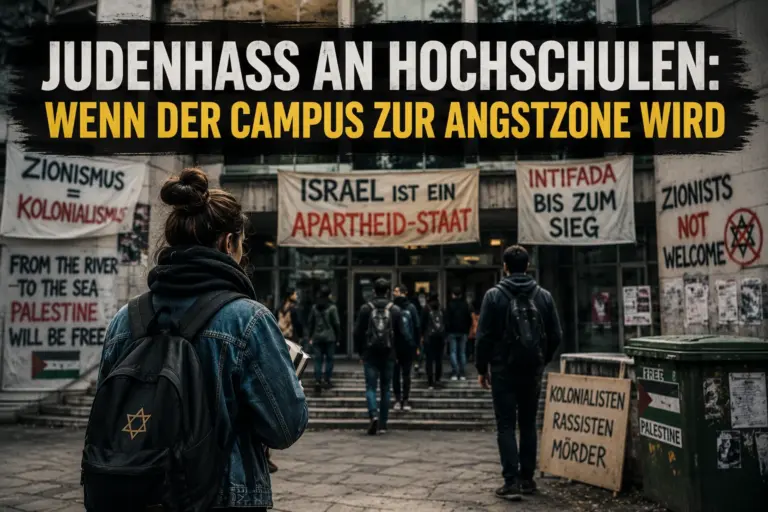
Universities between research and activism
Universities operate under different conditions from schools. Students are adults, academics enjoy freedom in research and teaching, and scientific progress depends on open disagreement about methods, results and conclusions.

Article 5, paragraph 3 of the German Basic Law protects art and science, research and teaching. The Higher Education Framework Act specifies this freedom, among other things, with regard to the choice of scientific questions, methodology, the assessment of research results and the expression of scholarly teaching opinions.
It would therefore be wrong to demand ideological neutrality from universities in the sense of political colourlessness. Scholars may advocate political positions, criticise theories and call for social change.
Academic freedom, however, does not protect only positions that are popular in society. It likewise protects uncomfortable questions and scientifically defensible theses, as long as they submit to open scrutiny.
A university does not become an ideological institution merely because left-wing, conservative, liberal or other political theories are taught there. It gets off balance when political assumptions are no longer examined, but merely taken for granted, or when the possibility of reasoned rebuttal is lost.
Science does not need an artificial quota of political camps. It needs something more demanding: a culture in which claims are examined, counterarguments are endured, and people are not automatically equated with every position they investigate or discuss.
Not every teacher is an activist, and not every criticism is imagined
The blanket claim that schools and universities are generally hotbeds of left-wing ideology goes too far. It overlooks the differences between federal states, types of schools, subjects, universities and individual teachers.
Many teachers struggle daily with cancelled lessons, language problems, bureaucracy, a lack of support and staff shortages. Many professors and lecturers conduct serious research and encourage open discussion. They do not deserve blanket political suspicion.
That does not mean, however, that institutional developments are fundamentally unproblematic. A system can develop a political bias without every participant acting consciously on ideological grounds. Curricula, training courses, funding programmes, administrative decisions and social expectations influence which topics move into the foreground and which questions are asked less often.
The decisive question is therefore not whether teachers or professors personally think in left-wing, right-wing, liberal or conservative terms. What matters is whether pupils and students learn to identify arguments, examine sources, tolerate disagreement and justify their position objectively.
Where this is possible, education fulfils its democratic mission. Where it is not, no matter how eloquent the mission statement, it will help.
✔️ In summary
Germany’s schools and universities are not ideologically indoctrinating institutions across the board. The measurable decline in performance and the danger of a narrowed culture of debate are nevertheless serious warning signs.
Education may convey democratic values, but it must treat politically and scientifically controversial questions as such. Diversity can enrich a society, but it does not release it from the need for a common language, binding rules and serious performance standards.
It is necessary to examine one’s own culture critically. Portraying it only as a burden is not enlightenment. And a university that replaces verifiable argument with political volume does not protect science, but merely its façade.
Education must rediscover the courage to demand excellence
The decisive alternative is not conservative education or left-wing education. It is education or paternalism.
A good education system demands achievement without abandoning children from disadvantaged families. It conveys democratic values without engaging in party politics. It treats other cultures with respect without disparaging its own across the board. It allows disagreement without turning every demonstrably false claim into an equally valid fact.
Above all, it takes young people seriously. It does not view them as malleable material for the next political campaign, but as future citizens who are expected to think, judge and assume responsibility themselves.
Where schools and universities fulfil this mission, they are not hotbeds of any ideology. Where they abandon it, convictions actually become a substitute for knowledge and moral certainty a substitute for education.
ℹ️ Factual basis and primary sources for the article 📑
▶️ OECD:
PISA 2022 Results, Country Note Germany
Official analysis of Germany’s results in mathematics, reading and science, including developments since 2012 and 2018 as well as information on social disparities and teacher shortages.
▶️ Federal Agency for Civic Education:
Beutelsbach Consensus
Presentation of the prohibition against overwhelming students, the requirement to present controversy, and the aim of enabling independent political judgment.
▶️ Federal Agency for Civic Education:
The Beutelsbach Consensus in Civic Education
In-depth classification of the three principles and their significance for teaching and civic education.
▶️ Federal Ministry of Justice:
Basic Law, Article 5
Constitutional basis for freedom of expression and the freedom of art and science, research and teaching.
▶️ Federal Ministry of Justice:
Higher Education Framework Act, Section 4
Specification of the freedom of research, teaching and study, as well as academic opinion-forming at universities.