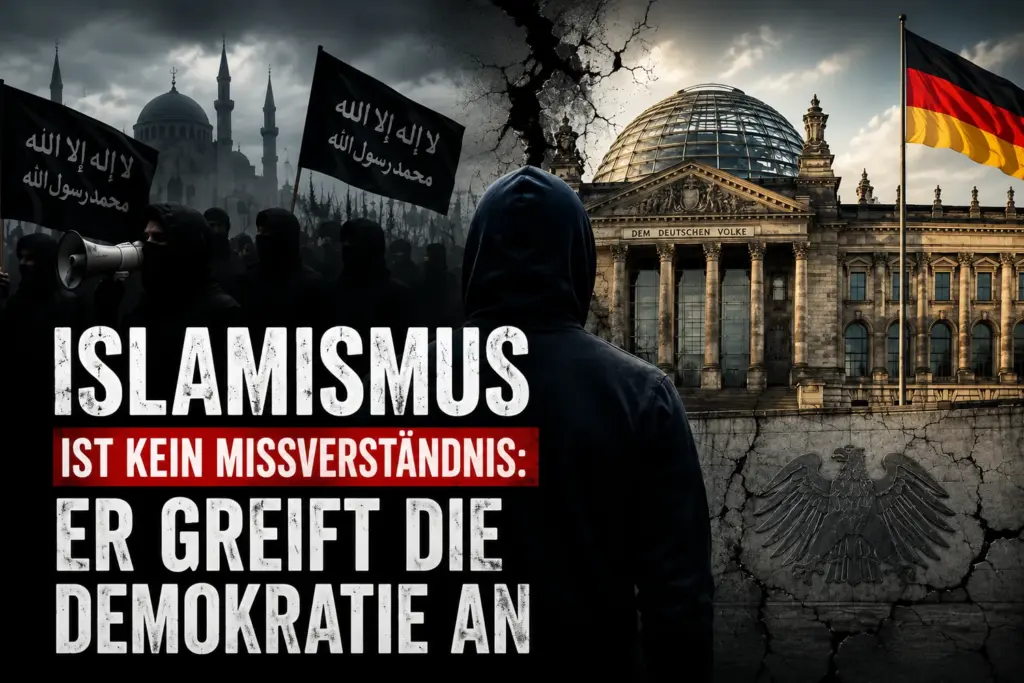

Islamism is not misunderstood piety. It is a political ideology with a clear claim to power that rejects the core principles of liberal democracy. Anyone who places religious commandments above democratically enacted law, relativises equality, spreads antisemitism or seeks a theocracy is not at the margins of a cultural misunderstanding. It opposes our free constitutional order.
The ethnologist and researcher on Islamism Prof. Dr. Susanne Schröter has been warning for years against playing down this danger. She headed the Frankfurt Research Centre for Global Islam and was a member of the expert panel “Political Islamism” of the Federal Ministry of the Interior. In her book published in 2026, “Left-wing, Right-wing, Islamist. The Real Enemies of Democracy” she takes aim at anti-democratic ideologies from different political camps.
Her central warning is uncomfortable but necessary: The Islamist threat does not begin with a terrorist attack. It begins where a political ideology attempts to place religious norms above individual freedom, democratic decisions and state law. In the worst case, the attack is the end of a development, not its beginning.

Passende X-Beiträge
Aus dem SCHLAGSEITE X-Archiv
Islamism Is Not Religion but Power Politics
The most important distinction must be clear: Islam and Islamism are not the same. A Muslim can be devout, conservative or strictly religious and still naturally stand on the foundations of the Basic Law. Islamism begins where religion becomes a political ideology of rule.
The Federal Office for the Protection of the Constitution describes Islamism as political extremism that places a supposed divine order above the democratic legal order created by human beings. This is not a marginal theological question, but touches on the core of the democratic state and the question of which law ultimately applies.
In Germany, no imam, religious movement or self-appointed religious authority decides what rights women have, which religion a person may leave, whom someone may love or which law applies to society. The standard is the democratic rule of law. Freedom of religion protects personal faith, but it does not protect a political claim to impose religious rules on other people.
Anyone who blurs this distinction is helping the Islamists of all people. For years, they have claimed that any criticism of their political ideology is an attack on Muslims. This tactic works remarkably well because parts of politics and the public sphere apparently fear naming political extremism as such whenever religion is involved. An extremist does not become any less extremist merely because they justify their political claim to power on religious grounds.
More than 28,000 people in the Islamist spectrum
The scale cannot simply be talked away. The 2025 report by the Federal Office for the Protection of the Constitution records an Islamist potential of 28,645 people , up from 28,280 the previous year. Of these, 9,110 people are classified as violence-oriented and the Salafist potential stands at around 11,200 followers.
These figures do not mean that more than 28,000 people are directly preparing attacks. Such a claim would be nonsense. But they do show that Germany is not dealing with just a few confused lone perpetrators, but with an ideological milieu of considerable size .

ℹ️ The total Islamist potential recorded by the Federal Office for the Protection of the Constitution stood at 28,645 people. Of these, 9,110 were assigned to the violence-oriented spectrum . Islamism must therefore not be equated with Islamist terrorism. Terrorism is the most violent part of a much larger political and ideological problem.
Anyone who only takes notice of Islamism when an attack occurs somewhere has not understood the problem. The terrorist often stands at the end of a radicalisation process. Before that come ideology, propaganda, recruitment, enemy images, social isolation and political influence.

The Most Dangerous Islamists Do Not Necessarily Carry Weapons
This is one of the most important points in Schröter’s warnings: Islamism does not operate exclusively through terrorist cells. An organisation can pursue anti-democratic goals without planning an attack tomorrow. It can reach out to young people via social networks, politicise religious identity, construct enemy images, divide society into believers and alleged opponents, and work over the long term to push democratic values back.
You do not need a suicide vest for that. A smartphone, a professional social media presence and enough ideological patience can be considerably more effective in spreading an extremist worldview.
How seriously the state has come to take such structures was shown by the Federal Ministry of the Interior in November 2025 with its ban on the organisation “Muslim Interaktiv”. According to the ministry, the group’s purpose and activities were directed against the constitutional order and the idea of international understanding. At the same time, premises belonging to “Generation Islam” and “Realität Islam” were searched.
This is precisely the challenge posed by such movements: They use modern forms of communication, target young people and present themselves as confident, identity-driven, rebellious and media-savvy. Their authoritarian core is concealed behind terms such as identity, self-determination or freedom of religion. A movement does not become democratic simply because it edits its propaganda professionally on TikTok.
Freedom of Religion Is Not a Shield for Extremism
The liberal rule of law protects freedom of religion, and for good reason. But it does not guarantee a religious special zone outside democratic criticism. Religious ideas may be criticised, religious organisations investigated, political demands rejected and extremist organisations banned when the legal requirements are met.
The Basic Law does not require submission to religious sensitivities. Nevertheless, a strange degree of political caution has developed over the years. As soon as Islamism is discussed, there is often first a linguistic obstacle course of distancing and caveats before the actual ideology is even addressed.
In the case of right-wing extremism, hardly anyone would think it necessary to explain at length first that, of course, not every German is a right-wing extremist. In the case of Islamism, however, such an obvious point regularly seems to require explanation. Muslims are not responsible for Islamists. But Islamists must not be hidden behind Muslims either.
Antisemitism Is Not a Side Effect
The ideological harshness of Islamism is particularly evident in its treatment of Jews and Israel. The Federal Office for the Protection of the Constitution describes antisemitism as a component of various Islamist currents. It is found among Islamist terrorist organisations as well as in the orbit of Hamas, Hezbollah, Salafist structures and other extremist milieus.
The ideological justifications differ, but the result is often frighteningly similar: Jews are declared the enemy and Israel is turned into a demonised state whose very existence is treated as a provocation.
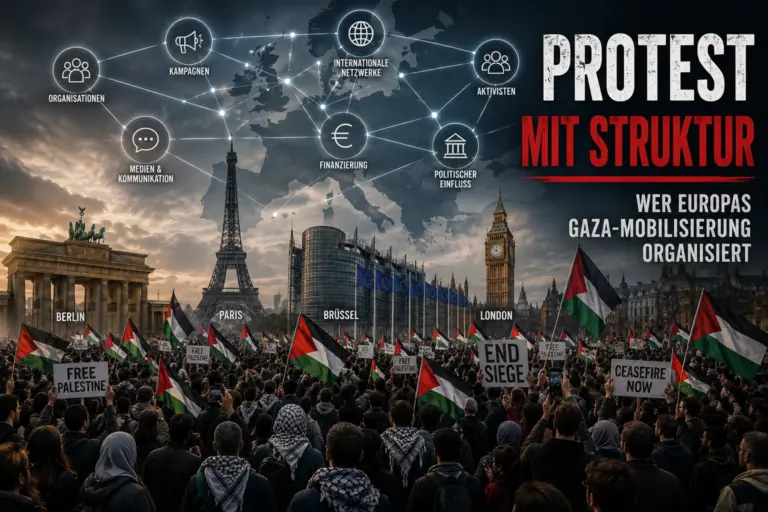
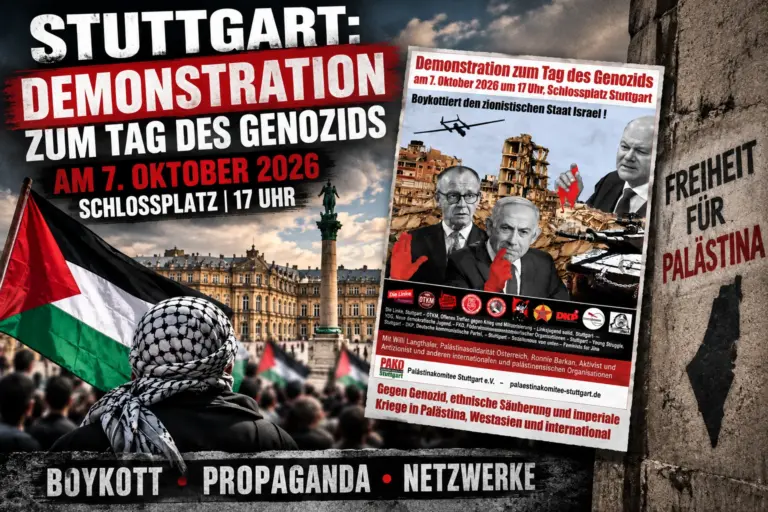
Since Hamas’s terrorist attack on Israel on 7 October 2023 this development has also become impossible to overlook in Europe. Demonstrations, propaganda and public campaigns showed how quickly purported Middle East policy can turn into open hostility towards Israel and Jews. The contribution “Media Manipulation in the Middle East Conflict” also shows how strongly images, headlines and narratives can shape perceptions of the conflict.
And yet the great linguistic contortion exercise began again afterwards: Was this really antisemitism? Was it perhaps merely “criticism of Israel”? Did one first have to explain the geopolitical context? No. When Jews are threatened, Hamas terrorism is glorified or the destruction of Israel is propagated, there is no need for a semantic treasure hunt. Hatred of Jews remains hatred of Jews, regardless of whether it comes from a neo-Nazi, an Islamist or a self-appointed anti-imperialist activist.

Islamism Does Not Become Less Dangerous Because Other Extremists Are Also Dangerous
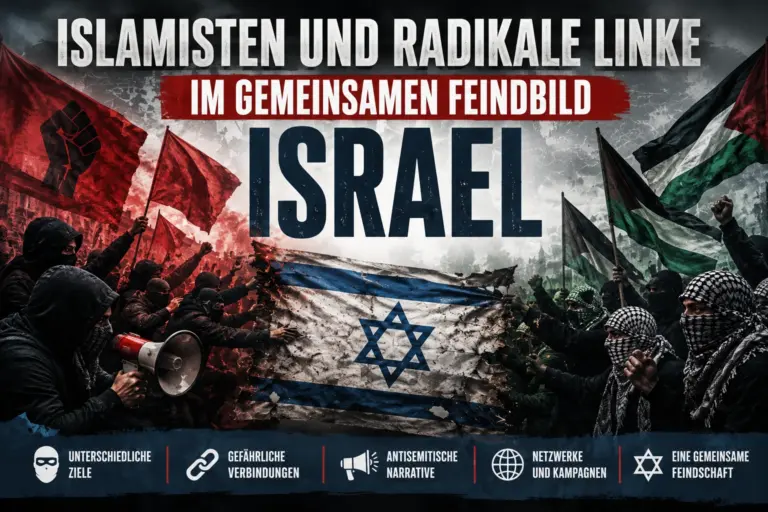
Right-wing extremists, left-wing extremists and Islamists pursue different goals and do not form a unified movement. Nevertheless, there are ideological overlaps that should not be ignored. Antisemitism is among the most visible. How political fringes can come together around the common enemy image of Israel is shown in the contribution “Enemy Image Israel: Why Extremists Come Together”. Added to this are, in some cases, anti-Americanism, authoritarian thinking and rejection of a society in which the individual counts for more than political or religious collectives.
It becomes particularly grotesque where parts of the political left romanticise Islamist movements as long as they are sufficiently aggressive towards Israel or the West. Anyone who defends women’s rights, sexual self-determination and individual freedom cannot simultaneously court religious extremists who reject precisely these rights. That is not solidarity, but political self-denial. The contribution “Antisemitism on the Left and among Left Youth” examines this development in greater detail.
The Federal Office for the Protection of the Constitution continues to describe right-wing extremism as the greatest threat to the free democratic basic order. That does not make Islamism one bit less dangerous. A democracy must fight all forms of extremism simultaneously. Anyone who offsets one danger against another is not practising security thinking, but factional thinking.
The decisive dividing line does not run between left and right. It runs between those who accept a free democratic order and those who want to replace it with an authoritarian ideology.
The Rule of Law Must Stop Apologising for Its Own Values
Germany does not need hysteria towards Muslims. It needs something considerably more uncomfortable: consistency towards Islamists. Anyone who wants to live here may, of course, believe whatever they wish, be conservative or strictly religious, visit mosques, fast and profess their faith publicly. But no one has the right to impose religious rules on other people or seek to replace the democratic order with a religious system of rule. The Basic Law is not subject to cultural disposition. This applies to women’s rights, freedom of religion, including the freedom to leave a religion, Jewish life and the rights of homosexual people. No one has to obtain permission for their freedom from religious fundamentalists. Hatred of Israel does not become any more acceptable merely because someone decorates it with religion, colonialism or supposed resistance.
Anyone who does not accept these principles does not have a problem with individual German laws. They have a problem with liberal democracy itself.
Looking Away Does Not Protect Democracy
Islamism does not disappear when one voices the word more cautiously. Nor does it become less dangerous when political leaders treat its ideological foundations as inconspicuously as possible out of fear of controversy. The answer can only be a consistent constitutional state governed by the rule of law.
Extremist organisations must be monitored and banned when the legal requirements are met. Terror financing and foreign influence structures must be pursued; antisemitic incitement and calls for violence must be consistently prosecuted under criminal law. Islamist propaganda targeting young people must not be trivialised as harmless identity politics or an exotic form of political youth work.
Above all, Germany must once again have the courage to stand up for its own values without apology. An open society must be tolerant, but it does not have to be tolerant towards those who use its freedom to abolish freedom.
That is precisely why Schröter’s warning is important. Not because every Muslim is suspect, but because Islamism is a political ideology whose authoritarian claim to rule is incompatible with a free society. Saying this clearly is not radicalisation. It is democratic self-defence.
Freedom of religion protects Muslims just as it protects Christians, Jews, atheists and every other person. However, it protects no political claim to rule over others. Islamism is an extremist ideology and must be treated as such. A democracy that no longer clearly names its opponents out of fear of uncomfortable debates makes itself weaker than it needs to be.
ℹ️ Factual basis and primary sources for the article 📑
▶️ Federal Office for the Protection of the Constitution:
Islamism and Islamist Terrorism in the 2025 Report on the Protection of the Constitution
Current figures on the number of Islamists, Islamists oriented towards violence and Islamist currents in Germany.
▶️ Federal Office for the Protection of the Constitution:
Islamism in Germany
Basic classification of Islamism as a political extremist ideology and distinction from the practice of religion.
▶️ Federal Ministry of the Interior:
Ban on the organisation “Muslim Interaktiv”
Information on the ban on the association and the searches connected with “Generation Islam” and “Realität Islam”.
▶️ Susanne Schröter:
Susanne Schröter’s website
Information on research, publications and academic work on political Islam and anti-democratic ideologies.
▶️ Herder Publishing House:
Susanne Schröter: “Left-wing, right-wing, Islamist. The Real Enemies of Democracy”, 2026.
Schröter’s current analysis of anti-democratic movements and ideological radicalisation.
🔎 Spotted an error, criticism or addition?
SCHLAGSEITE.eu stands for careful research and transparent corrections. Have you discovered a factual error, an unclear formulation or a broken link? Then send me your information. If possible, please provide a verifiable source.