
00:00 / –:–
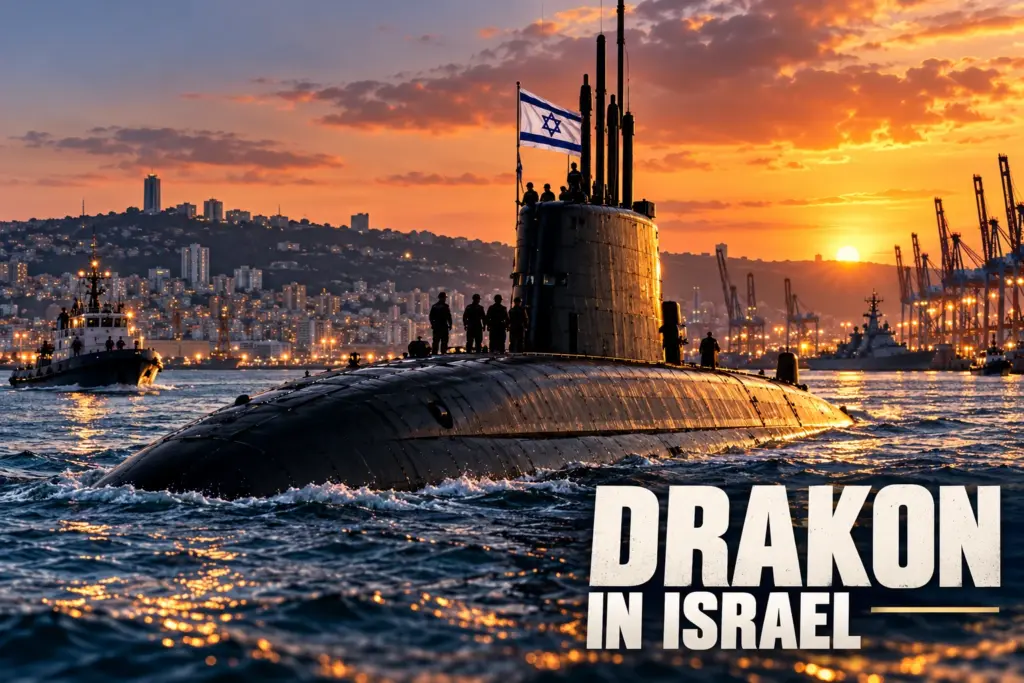
The INS Drakon arrived in Haifa on September 24, 2026. At the ceremony at the naval base, President Isaac Herzog, Defense Minister Israel Katz, Chief of Staff Eyal Zamir and Navy Commander Eyal Harel welcomed the sixth submarine of the Israeli Navy. Their message was clear: The Drakon is not simply another ship, but part of a navy intended to operate farther away, for longer and with greater concealment.
The ceremony followed a 23-day voyage from Kiel to Haifa. According to The Times of Israel the Drakon covered 3,792 nautical miles. Large parts of the voyage took place submerged and under a high level of secrecy, according to Israeli statements. The next phase now begins: Two to three months are planned for the installation and integration of Israeli systems. Full operational readiness will follow only later.
Passende X-Beiträge
Aus dem SCHLAGSEITE X-ArchivINS Drakon expands Israel’s strategic reach
Chief of Staff Eyal Zamir left little doubt at the ceremony about the role intended for the Drakon. With its induction, the navy would gain new capabilities and in future be able to operate “with greater concealment, farther, deeper and more lethally.” At the same time, Zamir turned his attention to Iran. The regime had been hit and weakened, but had not changed its intentions, he stated, according to a statement by the Israel Defense Forces.
Defense Minister Israel Katz expressed the political message even more directly. The submarine’s arrival was a signal to all those threatening Israel, above all the regime in Tehran. Distance offers Israel’s adversaries no immunity, whether in the air, on land or at sea.
President Isaac Herzog also placed strategic reach at the center of his remarks. Israel possessed capabilities that could, if necessary, be deployed thousands of kilometers from its own borders. At the same time, he pointed to the project’s particular German-Israeli dimension: 81 years after the Shoah, the Jewish state was building together with Germany a system it described as the “crown jewel” of defense technology.
Conclusion of the Dolphin AIP Program
The Drakon was built by TKMS in Kiel and is Israel’s sixth submarine. The fleet arithmetic is simpler than the various class designations might initially suggest: Three older submarines from the first Dolphin generation remain in service, and three boats from the Dolphin AIP generation have now been added. The Drakon is the third and final vessel of the latter group.
TKMS confirmed in early September, that the Dolphin AIP program was completed with the Drakon. This expressly does not mean the end of the Dolphin fleet. The three older boats will initially remain in service and are later to be gradually replaced by the forthcoming Dakar class.
At around 74 meters in length and approximately 2,600 tons, the Drakon is the largest and heaviest submarine in the Israeli fleet to date. Ten torpedo tubes are also publicly known. Planning, construction and testing extended over more than twelve years. The air-independent AIP propulsion system enables longer periods submerged and thus increases endurance and stealth above all.
Why the Drakon Is Not Called Dakar
The new submarine was originally supposed to be named “Dakar,” in memory of the INS Dakar, which sank in 1968 with 69 crew members aboard. Relatives of the crew at the time protested against reusing the name for a new individual ship.
The name ultimately chosen, “Drakon,” meaning dragon in German, was the compromise. According to Israel’s Ministry of Defense, the Hebrew name also contains the letters of the name Dakar, thereby continuing to commemorate the lost submarine and its crew. “Dakar” is now the name of the upcoming submarine class.
Israel’s Security Space Does Not End at the Coast
The significance of the Drakon becomes clear only when Israel’s geographical position is considered. The country has little strategic depth and is also heavily dependent on maritime trade. The Mediterranean, the Red Sea and the approaches to Israeli ports are therefore not peripheral areas of national defense.
At the latest since the war following October 7, 2023, this maritime dimension has become even more visible. The threat to international shipping routes posed by the Iran-backed Houthis in the Red Sea and the confrontation over strategic straits have further increased the navy’s importance. The Israel Defense Forces are therefore increasingly treating the sea as an independent strategic theater of operations.
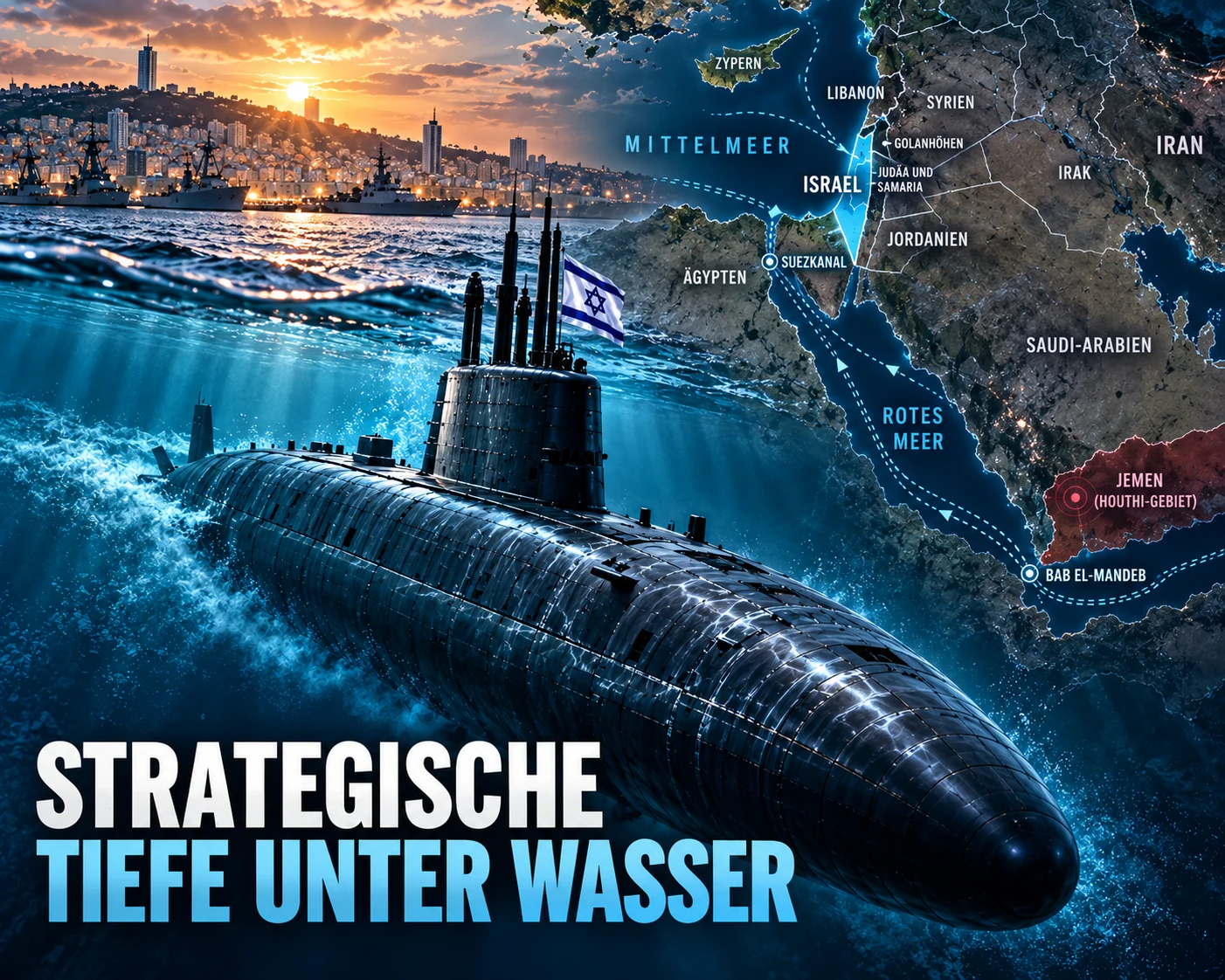
Submarines play a special role in this concept. Their central characteristic is their low visibility. They can be deployed covertly for extended periods, thereby enabling a military presence in regions where openly operating forces would be more easily detected.
Plan Choshen: The Navy Gains Greater Weight
The Drakon does not stand alone. Chief of Staff Zamir placed it within the IDF’s multi-year “Choshen” force-development plan. Under this program, the maritime dimension is to receive significantly greater weight than before.
The Drakon is the first major weapons system the Israeli Navy has received במסגרת this plan. Further new naval platforms are to follow. The goal is clear: Israel is to be able to operate at greater distances at sea, remain in the operational area for longer and have greater military impact there.
This gives the navy, often perceived as a smaller branch of the armed forces, a significantly greater strategic role. Protecting Israel’s coastline remains important, but it has long ceased to be the navy’s only task.
INS Drakon: German-Israeli Project with Delays
The Drakon is also a significant German-Israeli defense project. TKMS built the submarine in Kiel, and the three boats of the forthcoming Dakar class are also being built in Germany. The cooperation has existed for decades and is described by both sides as strategic.
The full story also includes the fact that testing of the Drakon, according to Israeli naval officials, was not free of political friction. The Times of Israel and Israel Hayom reported consistently that Denmark and Norway had not enabled TKMS to conduct certain tests in their waters or to use ports between tests. At that time, the boat was sailing under the German flag. Testing therefore had to take place farther out in international waters in the North Sea, which, according to the navy, delayed the program by several months.
For Israel, this is more than a footnote. Israel Hayom reports that the navy is concerned about whether political restrictions in Denmark, Norway, France or Canada could also complicate future work on the three Dakar submarines. Domestic political developments in Germany are therefore also being closely monitored. These are so far concerns on the Israeli side, not already adopted blockades of future deliveries.
The Next Generation Is Already Under Construction
The Drakon therefore marks the end of a procurement program, not the modernization of the fleet. Three submarines of the new Dakar class are already under construction. Beginning in the coming decade, they are to gradually replace the three older first-generation Dolphin boats.
The Drakon thus forms a bridge between two generations. It is larger than its previous sister ships and carries numerous Israeli systems whose exact capabilities have not been disclosed. At the same time, it remains part of the Dolphin AIP family and is not the beginning of the new Dakar class.

The exact armament and numerous technical capabilities of the INS Drakon have not been publicly confirmed. Media and analysts discuss additional capabilities based on the boat’s altered design. Israel and TKMS have not confirmed these speculations. Official statements, open technical data and analyses must therefore remain clearly separated.
The Drakon’s induction in Haifa was therefore more than the arrival of a new submarine. It marks the conclusion of the Dolphin AIP program and at the same time the beginning of a phase in which the Israeli Navy is receiving significantly greater weight in force development. That was precisely the message of the ceremony: Israel’s strategic security space does not end at its coast.
ℹ️ Factual basis and primary sources for the article 📑
▶️ Israel Defense Forces:
Ceremony marking the induction of the INS Drakon
Official information on the ceremony in Haifa, the statements by Chief of Staff Eyal Zamir and the submarine’s strategic role.
▶️ Israel Ministry of Defense:
Naming and strategic classification of the INS Drakon
Official information on the history of the name, the Dolphin AIP program and the forthcoming Dakar class.
▶️ TKMS:
Handover of the INS Drakon to the Israeli Navy
Manufacturer information on the completion of the Dolphin AIP program and the continuation of the program with the Dakar class.
▶️ The Times of Israel:
Israel’s 6th submarine to arrive as Navy plans major fleet expansion
Information on dimensions, the transfer route, the integration phase, fleet structure and the problems during testing in Northern Europe.
▶️ Israel Hayom:
INS Drakon submarine arrives in Israel
Report on the arrival, delays during testing and Israeli concerns about possible effects on the future Dakar class.
▶️ The Jerusalem Post:
IDF chief, Isaac Herzog hail INS Drakon arrival
Report on the ceremony and President Isaac Herzog’s statements on German-Israeli cooperation and strategic reach.
IDF: Drakon submarine has stronger weapons, longer underwater capabilities
Technical classification of the publicly known dimensions and the ten torpedo tubes.
🔎 Found an error, criticism or addition?
SCHLAGSEITE.eu stands for careful research and transparent corrections. Have you discovered a factual error, unclear wording or a broken link? Then send me your tip. If possible, please provide a verifiable source.