00:00 / –:–
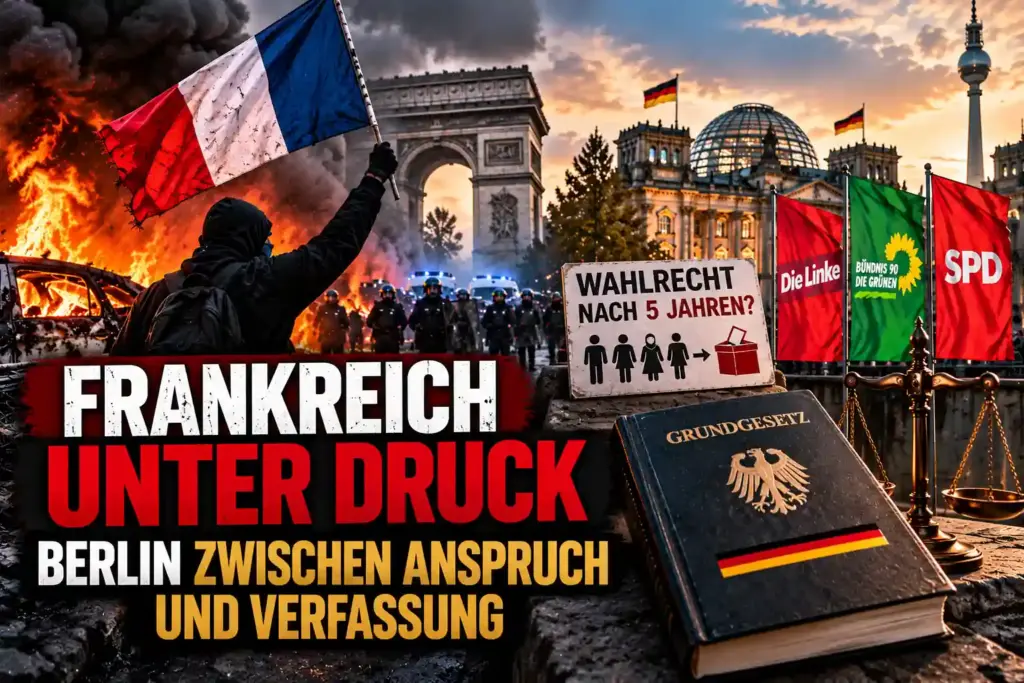
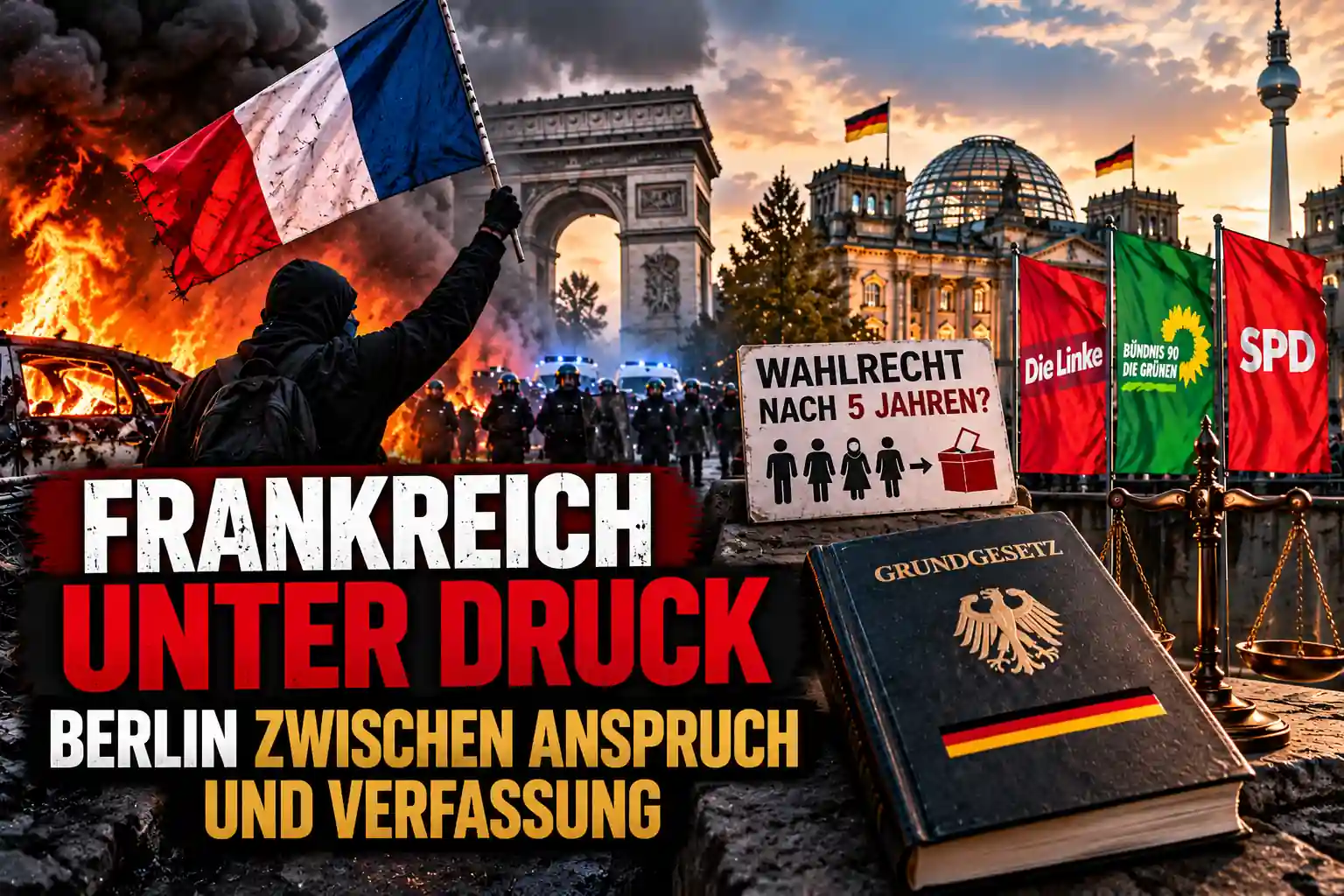
Public buildings are burning in France, shops are being looted and police officers attacked. The government is holding violent left-wing extremists in particular responsible for the escalation. At the same time, antisemitic slogans are appearing. While France is trying to regain control of its streets, the Left, the Greens and the SPD are negotiating a new government in Berlin. There, too, the issue is how to deal with antisemitism and extremism, as well as the limits of state responsibility.
When social protest turns into open violence
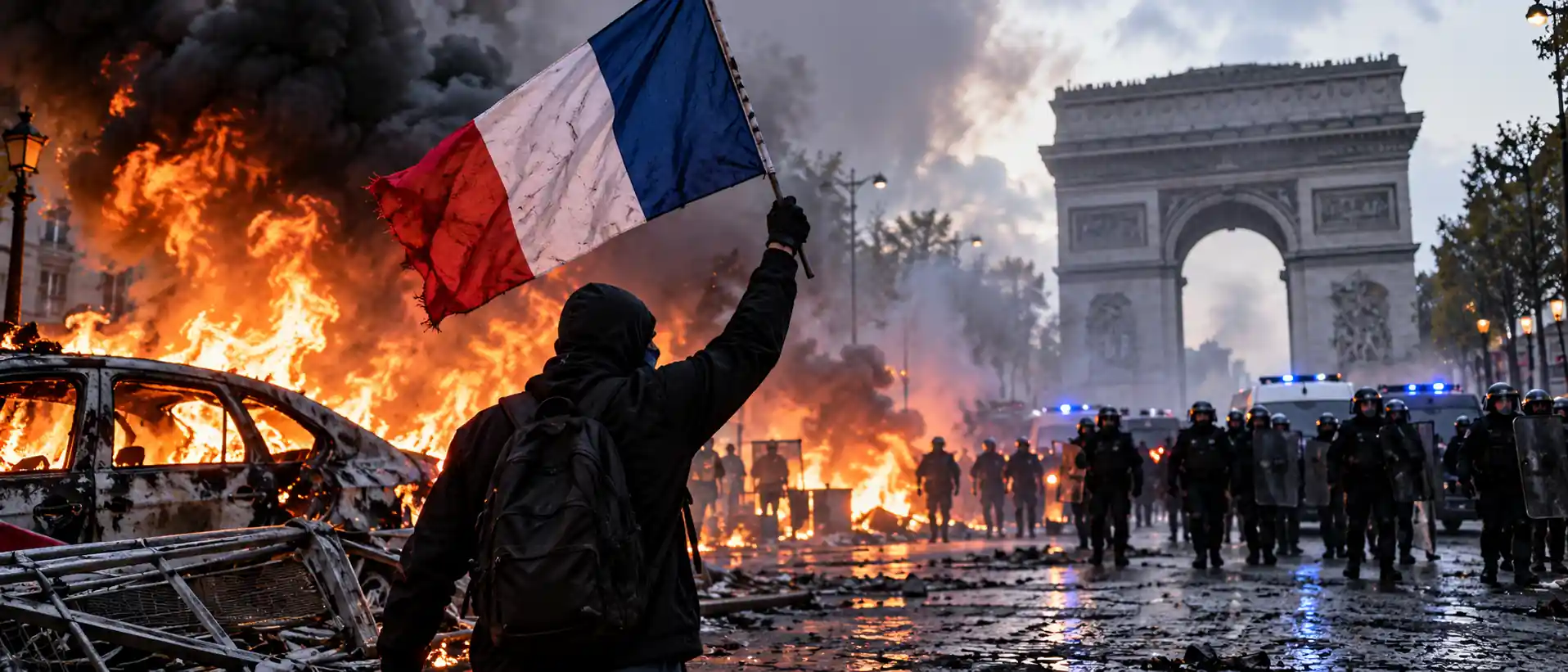
On October 17, 2026, protests against rising living costs and shortcomings in the French education system spiraled out of control. What began in many places as a peaceful demonstration ended in several cities with looting, burning vehicles, and attacks on the police. In Limoges, the historic town hall was severely damaged by fire. Massive riots also broke out in Paris, Marseille, and Lyon.
Following a report by the Associated Press news agency on October 20 , around 2,400 people were arrested in connection with the unrest. According to the French Ministry of Justice, more than 800 suspects were brought before prosecutors. Authorities imposed curfews in several cities. Prime Minister Sébastien Lecornu acknowledged mistakes in the police operation and announced significantly stronger security measures.
Passende X-Beiträge
Aus dem SCHLAGSEITE X-ArchivThe government is holding particularly violent far-left groups responsible for the escalation. As Le Parisien reported on October 20, Lecornu announced a massive police deployment for the next demonstration. The French government accuses violent groups on the extreme left of carrying out an organized campaign against state institutions. Interior Minister Laurent Nuñez described a targeted approach by small, mobile groups that committed violence simultaneously at different locations, thereby tying up police forces.
Investigators detained, among others, a suspect who is believed to be connected to the arson attack on Limoges City Hall. According to French media reports, the man is said to have contacts with radical environmental movements. Justice Minister Gérald Darmanin confirmed the arrest but did not comment on the suspect’s political background.
The original demands for affordable living and better schools were overshadowed by the violence. Anyone who loots shops, sets public buildings on fire or attacks emergency personnel is no longer demonstrating peacefully against political decisions.
The French government therefore faces a difficult task. It must prosecute the violence, address its own failures and prevent further demonstrations from escalating again.
New protests have already been announced for October 24. There are also further calls for mobilization at the beginning of November, including a trade union call for November 5. Lecornu has announced a significantly reinforced police presence for the next major demonstration.
Dealing with antisemitism: anti-Jewish hatred in the riots
Particularly revealing is an incident from Paris, reported on October 19 by the Jüdische Allgemeine .
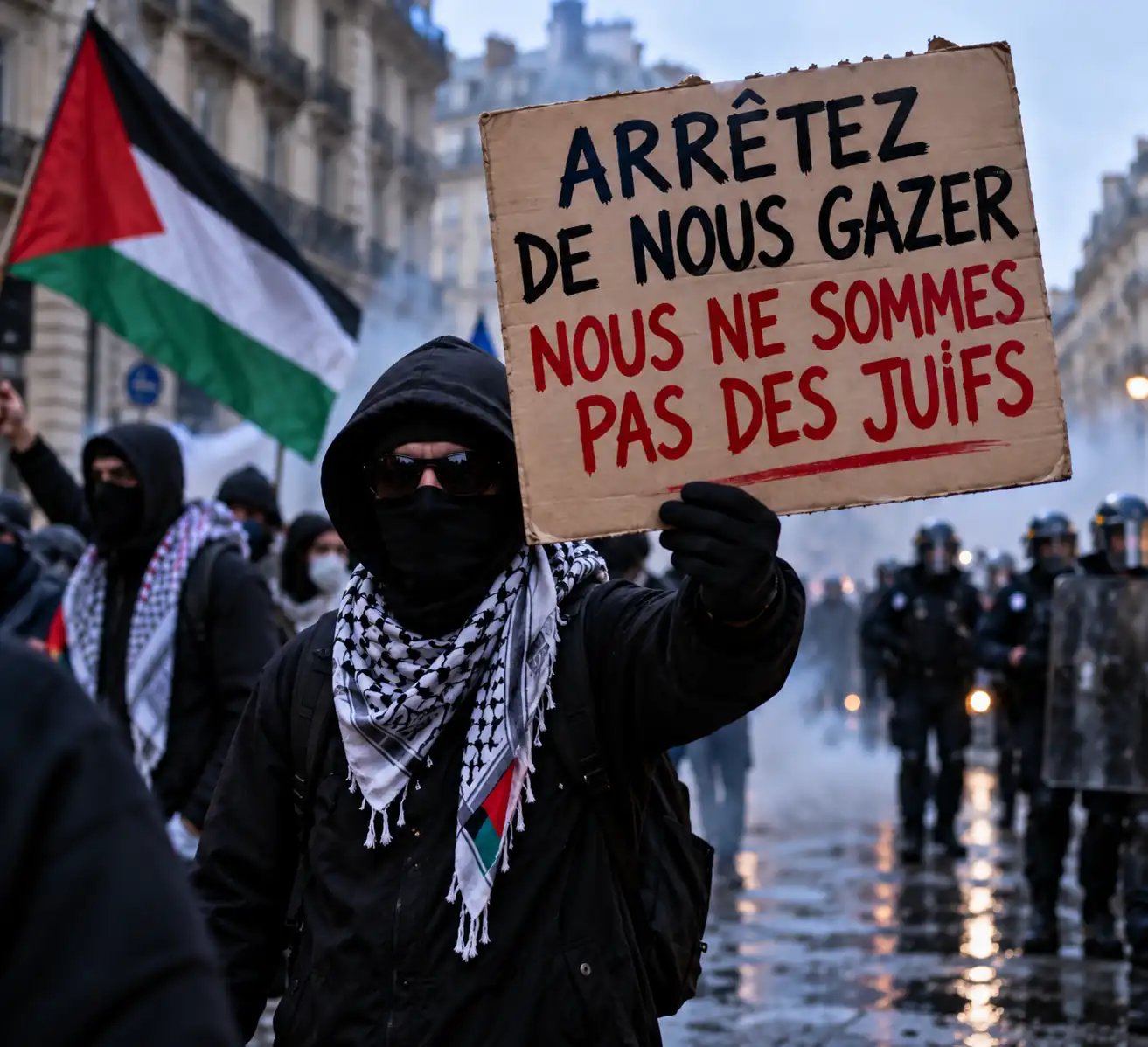
A video circulated via the French-Jewish information channel @mk_info_idf shows a masked demonstrator holding a sign that says in French:

„Stop gassing us, we are not Jews.“
In German: „Stop gassing us, we are not Jews.“
The sentence links the use of tear gas to the Nazi persecution of Jews and thereby abuses the Shoah for a political protest. The addition “We are not Jews” explicitly sets Jewish people apart from the demonstrators. The antisemitic message is unmistakable.
This illustrates a problem that extends beyond France. Antisemitism can apparently be incorporated effortlessly into entirely different political conflicts. At times, Israel serves as the enemy image; at times, the alleged power of Jewish interests; at times, the Shoah is abused for tasteless comparisons.
The involvement of violent left-wing extremists is explicitly identified by the French government. Central Islamist direction of the riots has not been proven by the investigative information published so far. The antisemitic incident in Paris is documented by the video described by Jüdische Allgemeine.
The fact that hatred of Jews appears even at demonstrations about the cost of living is a political warning signal.
Berlin and the unresolved issue of antisemitism
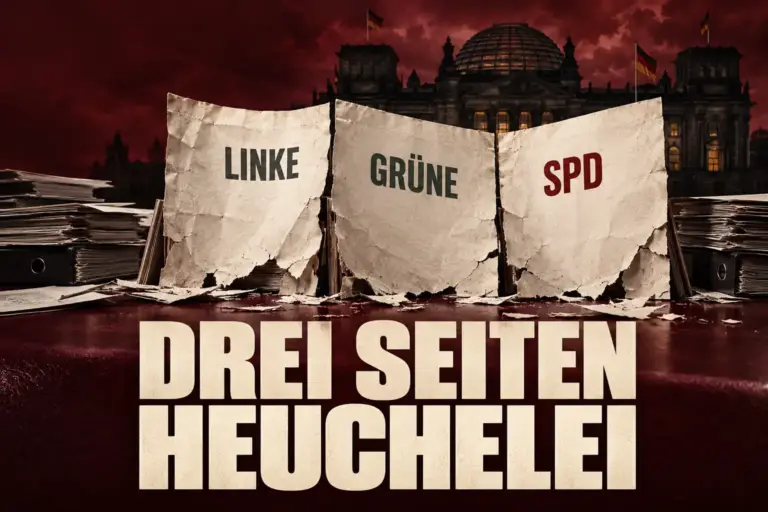
In Berlin, the possible formation of a government by The Left, the Greens and the SPD has been raising a similarly fundamental question for weeks: How binding are democratic principles when they are disputed within a party?
The conflict was sparked, among other things, by the admission of Vanessa Emde to the Berlin Left parliamentary group. Emde had stated that states had no right to exist, but people did. Her position on Israel’s existence as a state led to considerable disputes.
The SPD and Greens suspended their exploratory talks on 13 October after the Left parliamentary group adopted its own declaration on antisemitism. In key respects, this deviated from the declaration previously agreed jointly. Particularly contentious were the commitment to Israel’s right to exist and the envisaged consequences in cases of antisemitic incidents. This was reported, among others, by ZDFheute on 14 October.
On 17 October, the three parties finally agreed on a joint exploratory paper. The joint agreement on how to deal with antisemitism is intended to become part of a possible coalition agreement.
In it, the parties commit to protecting Jewish life and Israel’s right to exist. At the request of at least one parliamentary managing director, antisemitic incidents within the future coalition parliamentary groups are to be eligible for assessment by a three-member panel of experts.
An expressly envisaged possible consequence is also expulsion from the parliamentary group.
What is decisive, however, is who actually determines this in the end.
The panel of experts is to assess the respective incident from a professional perspective. However, it cannot itself expel anyone from a parliamentary group. The decision on consequences expressly remains with the parliamentary group concerned, which acts in accordance with its own statutes.
Thus, the final decision still rests with the political actors whose handling of antisemitism is supposed to be reviewed.
The committee’s professional standards are also not explicitly defined in the agreement. The paper does refer, with regard to administrative action, to the existing working basis of the Berlin state concept for addressing antisemitism. However, no separate binding definition is provided for assessing incidents within parliamentary groups.
For Jewish Berliners, therefore, the question of how detailed a coalition agreement is matters less. What will be decisive is what happens if a member of parliament once again expresses antisemitic positions or questions Israel’s right to exist.
The right to vote after five years of residence and the limits of the Basic Law
Another point of contention appears in the joint exploratory paper under the heading “Participation and Anti-Discrimination.”
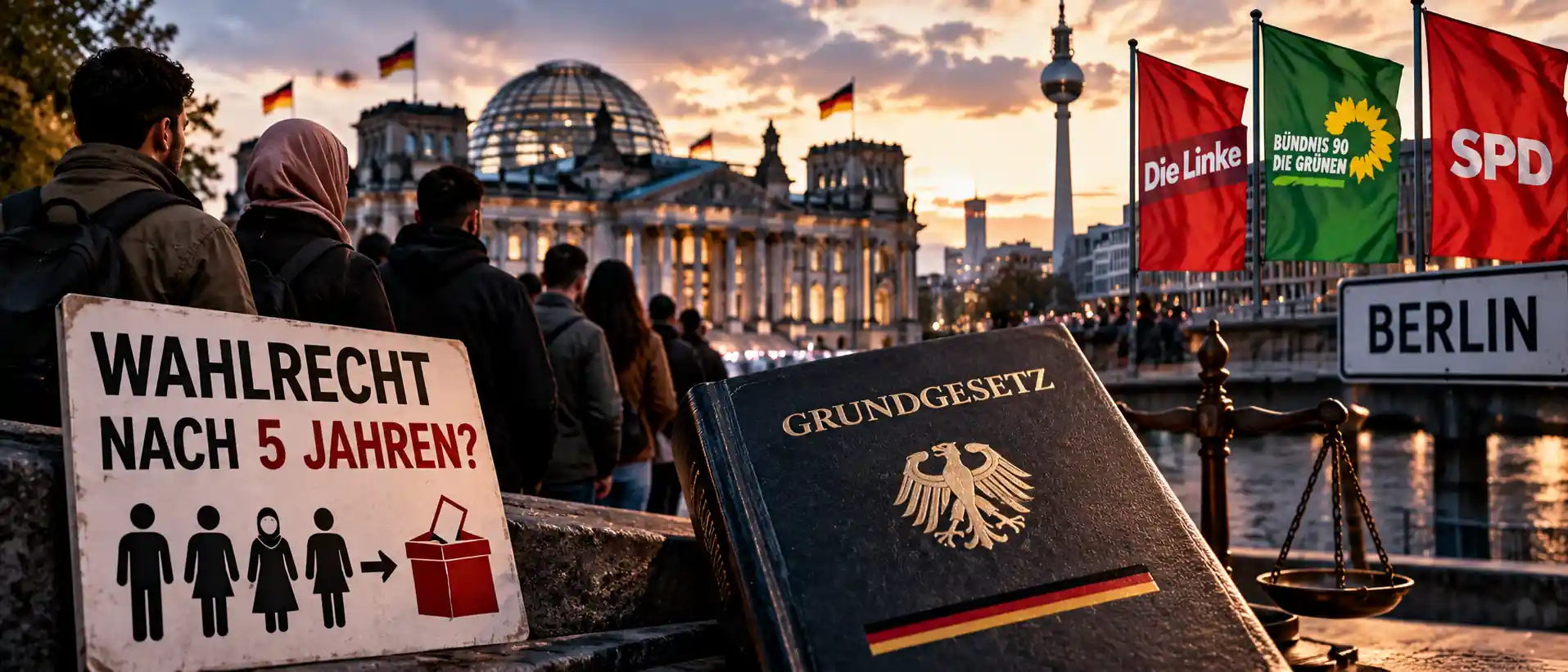
The Left, the Greens and the SPD want to advocate allowing people, after five years of residence in Germany, to vote and stand as candidates at the municipal and state levels, regardless of their nationality. The parties qualify this intention with the addition “within the scope of our powers”.
This concerns a core area of the democratic order.
Under the applicable Basic Law, German nationals have the right to vote in elections to the state parliaments. Citizens of other EU member states may additionally participate in municipal elections. For people from non-EU states, no such right to vote has existed after five years of residence to date.
The Federal Constitutional Court has repeatedly emphasized the link between democratic elections and the people of the state. The constitutional foundations arise in particular from Article 28 of the Basic Law.
Such an extension to third-country nationals would therefore require an amendment to the constitutional framework. Berlin could not simply introduce the proposed regulation through an ordinary state law.
Politically, the proposal is a demand for greater participation by people who have lived here permanently. Constitutionally, it raises the question of whether, and under what conditions, democratic voting rights should be separated from citizenship.
The parties have so far presented no concrete implementation path that is constitutionally viable.
France and Berlin: Why democratic states need clear rules
The unrest in France and the coalition negotiations in Berlin are different developments. But they show two areas in which democratic states need clear rules.
In France, the state’s monopoly on the use of force is directly at issue. People have the right to demonstrate and to sharply criticize political decisions. As soon as violence, looting and arson begin, the police and the justice system are called upon. The demonstrators’ political demands do not change the fact that such acts are punishable by law.
Berlin faces different decisions. Here, a possible government must clarify how it deals with antisemitic incidents within its own ranks, which security priorities it sets and how its political plans are compatible with the Basic Law.
On 19 October, Berlin’s Greens gave the green light for coalition negotiations by a large majority. The SPD state executive committee also approved them. Berlin’s Left Party wants to decide on the matter on 31 October.
A coalition has therefore not yet been formed. However, the substantive points of disagreement have already been documented.
Especially when it comes to protecting Jewish life, a government cannot rely solely on political declarations of intent. It needs verifiable procedures, effective security authorities and the willingness to apply its own rules to political allies as well.
The practical value of Berlin’s antisemitism agreement will be measured against this.
The decisive question is not Paris or Berlin
French authorities must explain why the riots were able to reach such proportions. The government has already acknowledged that it misjudged the security situation.
In Berlin, the decisions still lie ahead for the parties involved. The exploratory paper contains concrete plans to protect Jewish life, for policing and for political participation. Some of these plans will have to be judged by their implementation, others initially by their legal admissibility.
A democratic constitutional state does not demonstrate its strength through promises that are as sweeping as possible. What matters is whether it enforces its laws, effectively protects Jewish life and also lives up to its own political commitments.
France provides a serious reminder of this. Berlin must provide the answers to its own problems.
ℹ️ Factual basis and primary sources for the article 📑
▶️ Berlin parties: Original document dated 17 October 2026
More together, more Berlin: Exploratory result with Berlin antisemitism agreement (PDF)
Original document of the Berlin state associations of Die Linke, the Greens and the SPD. Contains the planned expansion of voting rights as well as, in Annex 1, the provisions on the expert panel and possible exclusions from parliamentary groups.
▶️ Basic Law: Article 28
Constitutional foundations of democratic elections in the states and municipalities
Official statutory text on democratic voting rights at state and local level, including the eligibility of EU citizens to vote in local elections.
▶️ Associated Press, October 20, 2026
Curfews imposed in French cities to prevent further rioting
Report on curfews, around 2,400 arrests, the appearance of more than 800 suspects before prosecutors and the government’s security measures.
▶️ Associated Press: Analysis of the riots
How France’s worst rioting in years erupted and how the government responded
Background on the riots, the damage to state institutions and the role of groups willing to use violence.
▶️ Le Parisien, October 20, 2026
Government reactions to the riots of October 17
Documents statements by Prime Minister Sébastien Lecornu and Interior Minister Laurent Nuñez, as well as preparations for the police operation on October 24.
▶️ SUD Éducation: Calls for mobilization
Overview of announced student protests and trade union actions
Documents, among other things, the call for mobilization on November 5, 2026.
▶️ Jüdische Allgemeine, October 19, 2026
We Are Not Jews: The Ugly Face of the French Riots
Commentary by Ute Cohen on the antisemitic incident during the French riots.
▶️ ZDFheute, October 14, 2026
Dispute over the antisemitism agreement in Berlin
Coverage of the conflict between Die Linke, the Greens and the SPD, the Left parliamentary group’s dissenting statement, and the interruption of the exploratory talks.
▶️ Tagesschau, 17 October 2026
Die Linke, the Greens and the SPD announce breakthrough in exploratory talks in Berlin
Report on the agreement on the joint exploratory paper and the next steps in forming the government.
▶️ Tagesschau / rbb, 18 October 2026
This is what Die Linke, the Greens and the SPD are planning for Berlin
Summary of key plans in Berlin’s exploratory paper.
🔎 Spotted an error, criticism or addition?
SCHLAGSEITE.eu stands for careful research and transparent corrections. Have you spotted a factual error, unclear wording or a broken link? Then send me your tip. Please provide a verifiable source where possible.