
00:00 / –:–
Gastbeitrag von Nida Banou

Rise Iran & Javid Shah | anti-postkoloniale Ideologie & anti-Islamismus | Eure Freiheit ist heilig. Beschützt sie.
If you are wondering about the lack of empathy for Israel’s victims; about the massive escalation in France; about the conspicuous indifference toward the persecution of Christians, Jews and other minorities when the perpetrators are Muslims or Islamist actors; if you are asking yourselves why Iranians who rise up against an Islamist dictatorship suddenly receive far less solidarity as soon as their revolution no longer appears as a form of feminism compatible with the West, but instead articulates itself as national, secular, anti-Islamist and patriotic and pro-Pahlavi; if you are asking yourselves why precisely those who defend Hamas, Khamenei or other authoritarian movements can at the same time present themselves as representatives of human rights and anti-racism—then it is worth looking not only at the individual events.
We need to examine the moral map we have created for ourselves over the past decades.
An important part of its ideological underpinning comes from postcolonial and related theories critical of power. Their original contribution was necessary: They made visible the fact that colonialism, racism, and domination do not function only through weapons, but also through language, institutions, and the power to shape interpretation. The problem begins where this perspective ceases to be an analytical tool and instead becomes a universal explanation of the world.
History is then increasingly read along a single axis: the powerful and the powerless, oppressors and oppressed, center and periphery, colonizers and colonized. White skin (perpetrators) and dark skin (victims).
And because Europe and the West almost automatically occupy the side of power in this historical narrative, this all too easily leads to a moral simplification: The West is no longer viewed as a civilization that has produced both the Enlightenment and colonialism, human rights and crimes, self-correction and power politics. It becomes a perpetrator category.
At the same time, other histories of conquest and empire astonishingly easily disappear from view—for example, the Arab-Islamic expansion spanning centuries, which was associated with war, subjugation, Arabization, religious hierarchization, slavery, and the displacement of older cultures and religions.
What is naturally analyzed as a history of domination and colonialism in the case of European imperialism is not even placed in the same historical category in the Arab-Islamic context.
Passende X-Beiträge
Aus dem SCHLAGSEITE X-ArchivThis is how selective historiography emerges.
European expansion is regarded as a morally formative legacy into the present, while non-Western empires and their victims largely disappear from collective memory. As a result, other societies are not viewed with the same historical and moral rigor, but understood primarily through their later position toward the West.
This is precisely how the standard shifts. It is no longer the act alone that determines our judgment, but increasingly the presumed position of the actor within a hierarchy of power and victim status. Violence from above is considered structural violence. Violence from below is given context.
One side bears responsibility; the other, initially, has reasons.
One perpetrator has to justify himself, while with the other, the first question asked is what might have radicalized, marginalized, or harmed him.
This is the point at which a theory that was originally emancipatory has tipped into moral asymmetry. Antisemitism can then be judged more leniently under the label of “anti-Zionism.” Islamist ideology appears more as a reaction to Western dominance than as an independent project of domination. The oppression of women is viewed with cultural sensitivity as long as it takes place outside the West. And religious persecution receives varying amounts of attention—depending on which groups fit the familiar perpetrator-victim pattern.
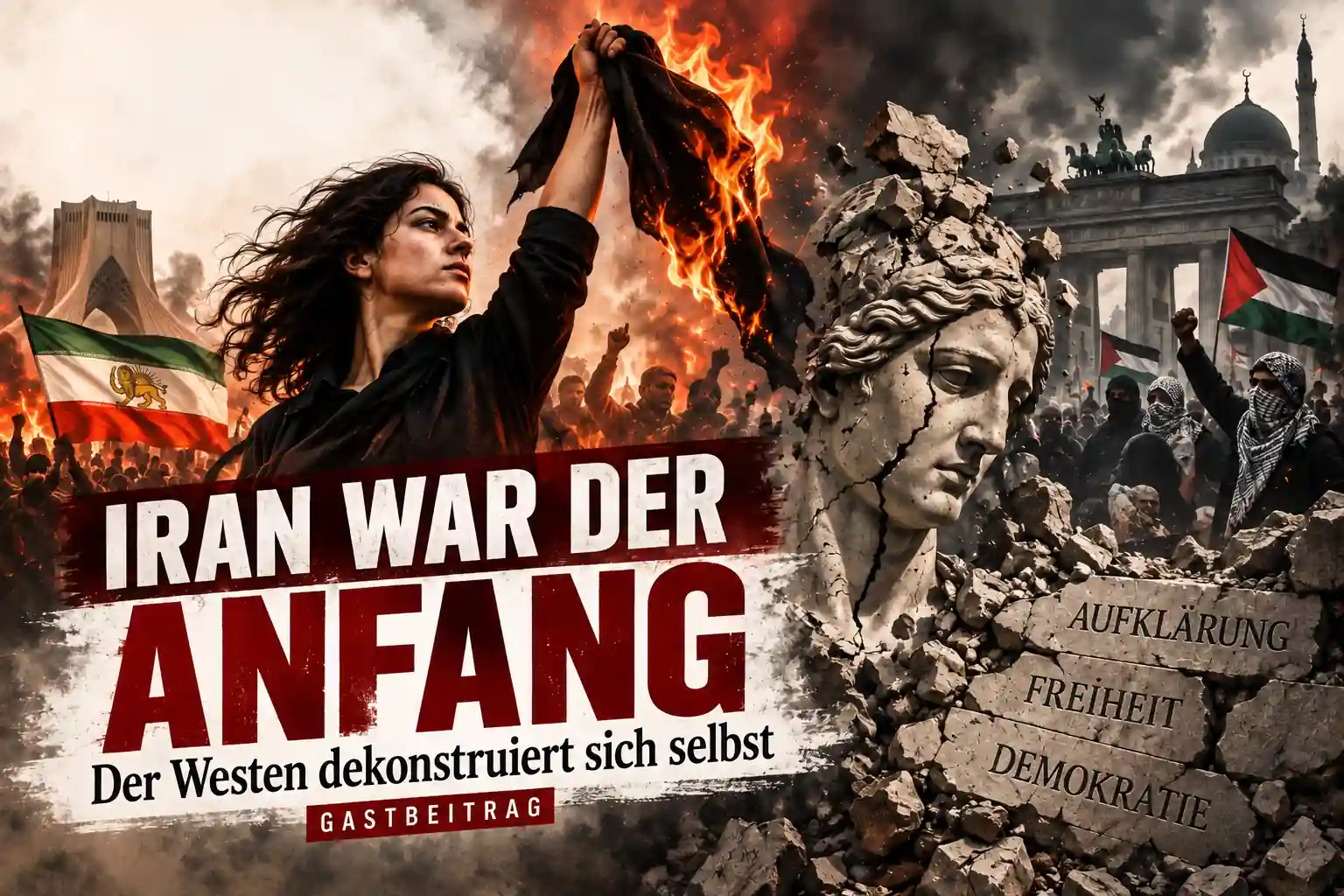
Iran—my country of origin—is an almost textbook example of this.
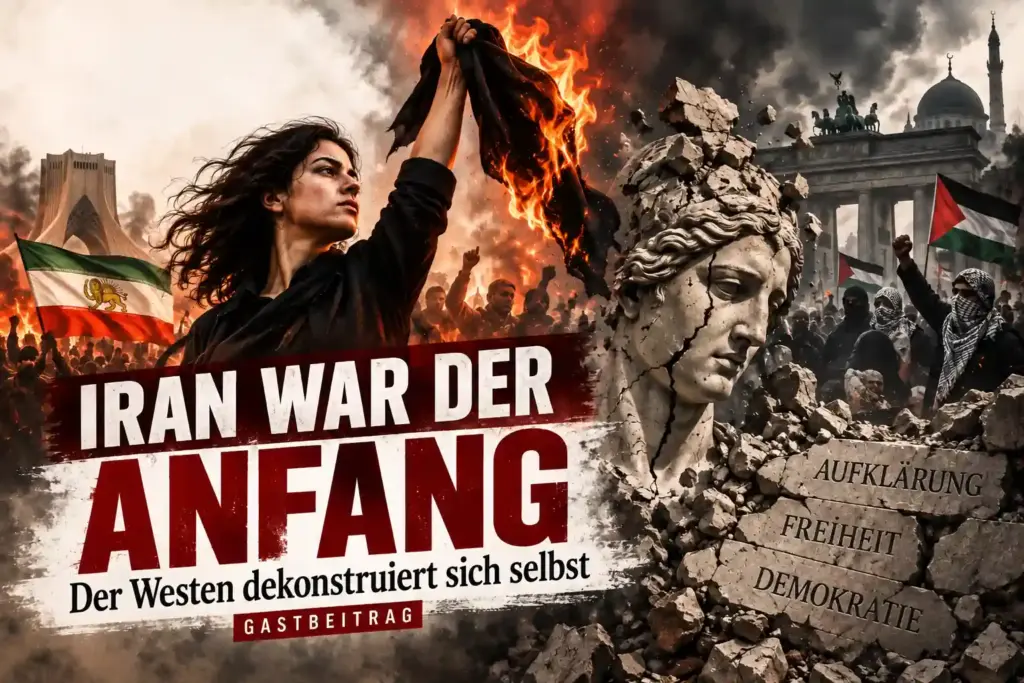
As long as the uprising against the Islamic Republic could be read in the West as a feminist revolt against “old men” under the banner of “Woman, Life, Freedom,” it fit perfectly into existing categories.
But at some point, the Iranian movement could no longer be reduced to that. It became increasingly openly national and patriotic, increasingly clearly directed against the Islamist order as such, and for many Iranians it also became a return to an Iranian identity beyond the ideology of 1979.
Millions of people carried the Lion and Sun flag, chanted national slogans, shouted “Long live the King,” and explicitly linked their demand for freedom with the rejection of political Islam.
And suddenly, this revolution became “complicated” and “problematic” for its former “progressive” supporters. For here, a non-Western society was rebelling not against Western colonialism, capitalism, or the West.
She rebelled against Islamism, Islamic expansion and forced identity.
Women did not want Western feminists to contextualize their hijab culturally. They wanted to burn it (and did so!). The men were not standing beside them as patriarchal adversaries; they were persecuted and killed alongside them. People from a Muslim-influenced society themselves explained that their oppression stemmed from an Islamist state ideology.
This brought their experience into conflict with a political language accustomed to viewing Islam primarily as an object of Western discrimination. The Iranians were unambiguously victims—but not the victims expected by the familiar framework. And it is precisely here that the weakness of a morality becomes apparent that judges people first according to groups and only afterward according to actions.
We encounter the same problem elsewhere. When Jewish victims are no longer perceived simply as human beings, but first as members of a state understood as powerful; when Israeli women are not believed regarding the sexual violence; when Christians in countries outside the West are persecuted without this giving rise to comparable political mobilization; when violence perpetrated by members of a minority is explained in a different language from violence against a minority, then we have already abandoned universalism.
And with this loss, something larger begins: the deconstruction of one’s own values.
For when truth appears only as a product of power, at some point even the idea of a shared truth becomes suspect. When norms are read primarily as instruments of domination, necessary norms also lose their legitimacy. When tradition is understood first and foremost as oppression, a society loses faith in its own cultural memory. When borders appear mainly as exclusion, their very existence already becomes morally problematic. And when one’s own history is told almost exclusively through guilt, a generation eventually emerges that has learned exceptionally well how to dismantle its heritage, but scarcely knows anymore what of it should be preserved.
This does not remain an academic matter. A society depends on its members accepting some common standards despite all their differences: that violence is wrong, that terrorism is wrong, regardless of who commits it; that human rights apply universally; that truth does not depend entirely on identity; that religious or ethnic background confers neither more nor less moral responsibility on anyone; that freedom may be defended.
Anyone who replaces these common standards with a politics of competing group identities inevitably produces division. People then no longer encounter one another first and foremost as citizens of the same society, but as representatives of historical collectives: privileged or marginalized, perpetrators or victims, majority or minority. Each group develops its own memory, its own injury, its own truth and, ultimately, its own morality.
A society can speak about diversity in this way for a very long time while possessing less and less in common.
That is perhaps the deepest consequence of this development. Not that we have learned to criticize power. That was necessary. Not that we have come to terms with our history. That, too, was necessary.
But rather that, in parts of our culture, self-criticism has turned into distrust of the idea of our own civilization.
The West does not have to believe that it is superior in everything. But it should once again know which of its principles are non-negotiable: individual freedom, equality before the law, the separation of religion and political rule, freedom of expression, protection of the individual from the collective, and the universal dignity of every human being.
For universalism precisely means that I apply the same standard when the victim is Israeli, Iranian, Christian, Muslim, or atheist—and likewise when the perpetrator belongs to a majority or a minority.
A society that forgets this loses not only its moral compass. At some point, it also loses what holds it together.
And therefore, one final appeal to the West: Look to Iran.
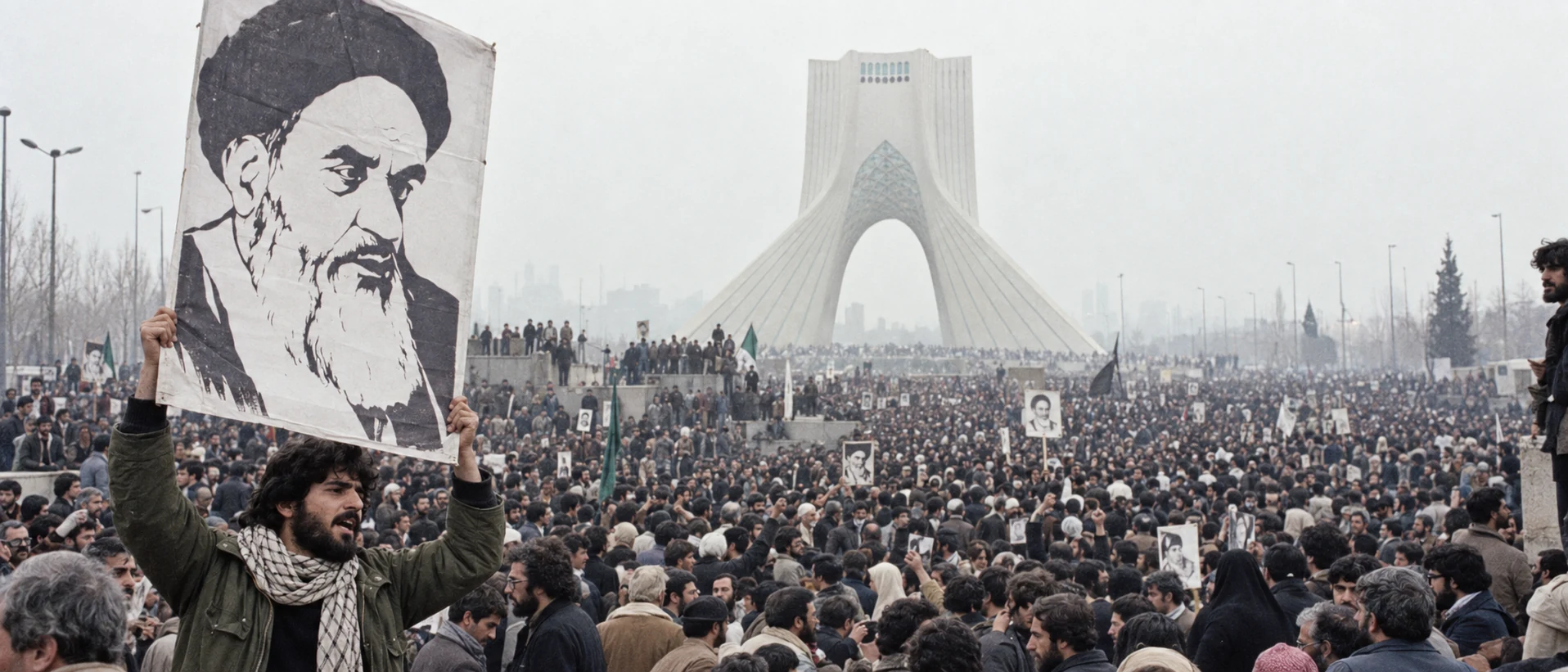
In 1979, it became clear what can happen when leftists and Islamists join forces out of hatred for the existing order. Each side believes it can use the other. In the end, they themselves are devoured.
And to this day, hatred of their old enemy—the Shah, the USA and Israel—binds them so strongly that left-wing Iranian-born activists and journalists still try to whitewash their parents’ dirty part in this story and tragedy of Iran. Public broadcasting is full of them.
Iran was not the end of this story. Iran was the beginning.
Look at Great Britain. Look at France. Look at the elite universities of the USA.
Anyone who downplays Islamism out of ideological affinity, a sense of guilt or revolutionary romanticism should know where such alliances will lead.
The Iranians know the price and pay it every day.
The West should not have to pay it again.