

00:00 / –:–
Wolfgang Benz warns against the inflationary use of the term antisemitism. Yet, of all things, when it comes to Jewish security in Berlin and Israel-related antisemitism, his own argument is remarkably lenient. He classifies calls for Israel’s destruction as political hostility, points to police protection as an argument against insecurity in Jewish life, and asks why Jews remain in Germany at all. Berlin’s reality tells a different story.
The occasion is specific. At an election campaign event held by the Neukölln Left, the slogan “Death to the IDF” was heard. In the Tagesspiegel interview of September 25, 2026 Benz does not derive a finding of antisemitism from this. He states his basic position unambiguously: The Left is not antisemitic.
He classifies anti-Israel statements from parts of the party’s milieu as political hostility toward Israel, which he describes as an occupying power. Even when slogans wish for Israel’s downfall, he denies that they have a directly anti-Jewish character.
This is not an incidental choice of words. It is the core of his argument: Benz draws a dividing line between hostility toward Jews and hostility toward Israel that is supposed to appear far cleaner in political reality than it actually is.
Passende X-Beiträge
Aus dem SCHLAGSEITE X-ArchivBenz recognizes antisemitic slogans and downplays hostility toward Israel
Benz should not be portrayed more smoothly than he expresses himself. He does not consider the relevant slogans reasonable or harmless. He describes them as misanthropic, wrong, and denunciatory. He demands that the Berlin Left leadership take clear action against the activists concerned and formulates this demand in the interview in notably drastic terms.
That is precisely what makes his subsequent exoneration not weaker, but more contradictory.
Benz recognizes a milieu against which, according to his own account, the party leadership must take decisive action. He recognizes misanthropic slogans. He recognizes a problem of demarcation. Nevertheless, he declares the party categorically non-antisemitic and shifts Israel-related antisemitism into the category of mere political opposition.
That is the real gap in his argument. The individual elements are acknowledged as problematic, while the pattern is rejected at the same time.
To assess a party or political scene, neither a blanket acquittal nor a blanket condemnation is sufficient. What matters is whether party branches, events, alliances, and officeholders tolerate or normalize anti-Israel or antisemitic rhetoric, or consistently oppose it.
Israel-related antisemitism does not fit Benz’s clear-cut distinction
Benz’s description of Israel as an “occupying power” is not neutral either. It already establishes a political framework before the specific sentence, slogan, or political objective has even been examined.
That is precisely where the problem lies. Political opposition to Israeli government policy, Israel-related antisemitism, and the negation of Jewish self-determination are three different things. In reality, however, they frequently overlap.
The 2025 Berlin Constitutional Protection Report describes precisely this intermingling. The agency characterizes the foreign-related extremist scene as substantially shaped by anti-Israel and antisemitic actors. It documents events at which Israel’s right to exist was negated and Hamas terrorism celebrated.
Practical reality therefore does not adhere to the neat compartment into which Benz places it. Political hostility toward Israel and antisemitism can occur separately. But they can just as easily overlap. Anyone who systematically leaves out this second aspect does not gain precision. They lose it.
Police protection for Jewish institutions shows the real threat
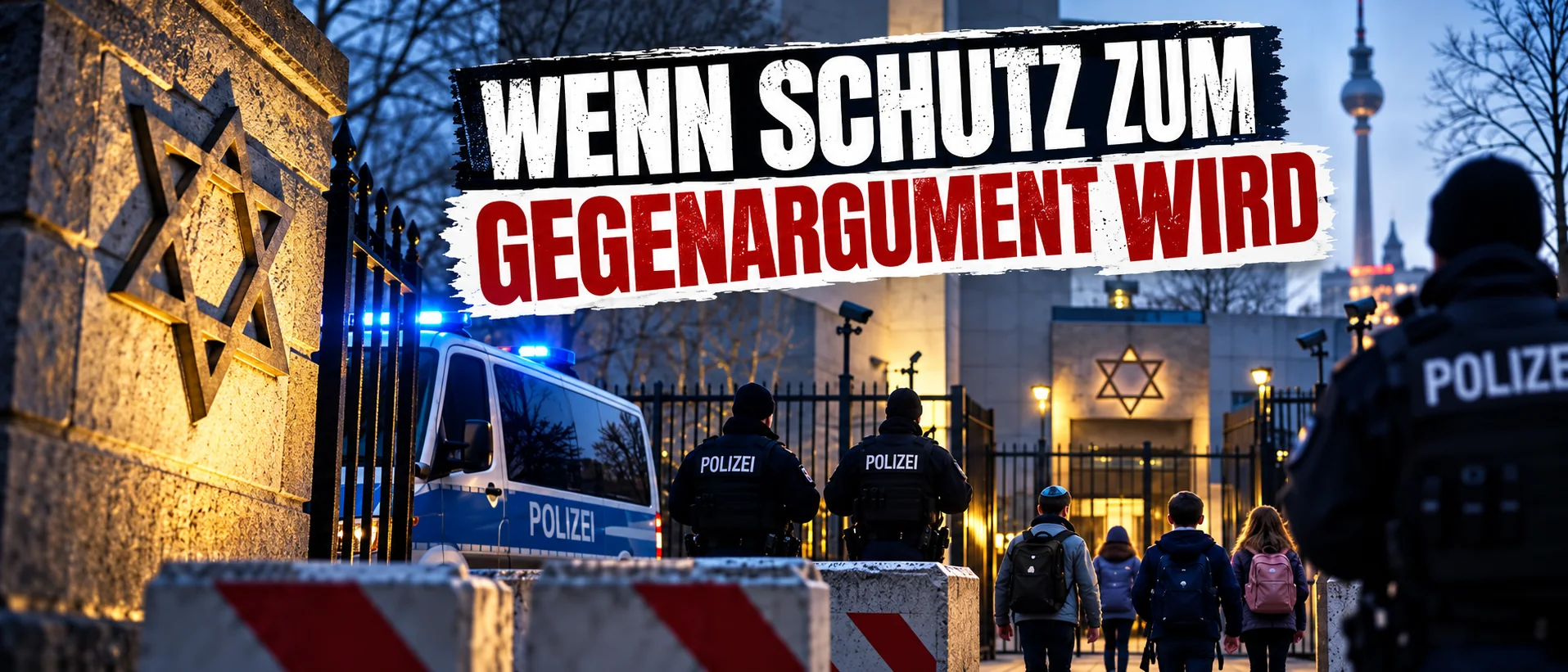
This becomes particularly clear in Benz’s statements about the security of Jewish life. He points out that Jewish institutions are protected especially intensively by the police. When the Tagesspiegel refers to police vehicles outside Jewish schools, Benz replies: That is precautionary.
The sentence is noteworthy because no one needs to claim that an immediate perpetrator is standing outside every Jewish school every day. That would be a grotesquely high threshold for the concept of a threat.
Police protection is put in place because security authorities assess a threat and consider protective measures necessary. A synagogue does not need a police post because everything is wonderfully safe. A Jewish school is not protected because antisemitism is merely imagined. Protection is the response to the danger.

Invoking precisely the security measures established because of a threat as an argument against that threat reverses cause and effect. Concrete barriers, police vehicles, and security for premises are not a Jewish privilege. They are the visible price of a security situation that makes such measures necessary.
2,268 antisemitic offenses in one year
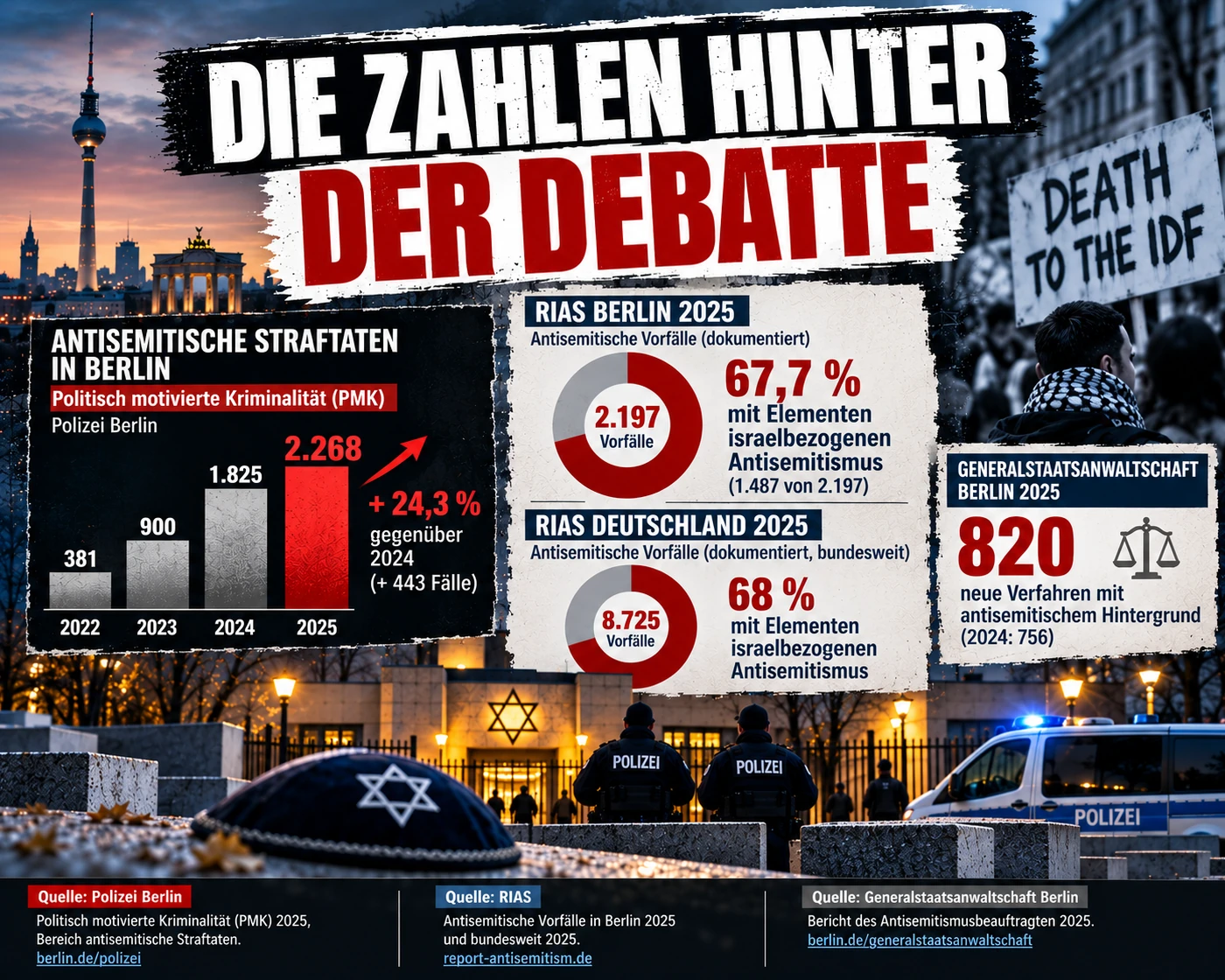
The figures from Berlin make any downplaying difficult. According to the Berlin Senate Department for the Interior 2,268 antisemitic offenses were registered in Berlin in 2025. That was 443 more cases than in the previous year, an increase of 24.3 percent.
A total of 1,485 of these offenses were assigned to the phenomenon category “foreign ideology.” This category describes neither an ethnicity nor a religion. It must therefore not simply be equated with Arabs, Muslims, or Palestinians.
What matters is what the authorities themselves determine about the ideological scene. For 2025, the Berlin Office for the Protection of the Constitution explicitly describes anti-Israel and antisemitic actors, anti-Israel propaganda, the negation of Israel’s right to exist, and the glorification of Hamas terrorism.
This is not a political rebuttal by a supporter of Israel. It is an official assessment of the situation.
67.7 percent involving Israel-related antisemitism
The statistics are particularly clearly at odds with Benz’s sharp distinction between Israel and antisemitism.
RIAS Berlin documented a total of 2,197 antisemitic incidents for 2025. Elements of Israel-related antisemitism were identified in 1,487 cases. That is 67.7 percent. This is not a marginal phenomenon. It is by far the dominant form.
The same picture emerges nationwide. The Federal Association of RIAS documented a total of 8,725 antisemitic incidents in 2025. Sixty-eight percent of them were classified as involving Israel-related antisemitism. Thus, the very form that Benz rhetorically separates most sharply from genuine hostility toward Jews is, in the actual incident statistics, the most frequent context.
Of course, this does not mean that 68 percent of all criticism of Israel is antisemitic. RIAS does not count ordinary political criticism as an antisemitic incident. The figure describes incidents already assessed as antisemitic in which reference to Israel constitutes one manifestation. The distinction is crucial.
Between 2018 and 2022, RIAS Berlin documented an average of just under 980 antisemitic incidents per year. In 2025, there were 2,197. The level has shifted permanently upward since October 7, 2023.
A knife attack is not a theoretical threat
How real the threat can be is shown by a case from February 21, 2025. A 19-year-old at the time attacked a visitor with a knife at Berlin’s Memorial to the Murdered Jews of Europe.
The Berlin Higher Regional Court assessed the act in March 2026 as Islamist and antisemitically motivated. According to the court’s findings, the perpetrator deliberately chose the memorial as the crime scene and wanted to target an Israeli or Jewish person there in particular. At the time of the press release, the judgment was not yet legally final.
This case does not prove that every Jew in Berlin is attacked every day. That would be an absurd claim.
But it does show very concretely why the security issue cannot be dismissed with the word “precautionary.” The antisemitic threat is not a theoretical sensitivity of Jewish communities. It can turn into real violence.
The Berlin Public Prosecutor General’s Office cites this very attack in its report on antisemitism in 2025 as an example of the danger posed by antisemitically motivated offenses.
Benz’s own definition does not allow for such certainty
There is also a notable contradiction with the definition of antisemitism that Benz himself supports.
Wolfgang Benz is one of the signatories of the Jerusalem Declaration on Antisemitism. This declaration was developed specifically to distinguish criticism of Israel from antisemitism more precisely than the IHRA working definition. Yet even this deliberately narrower definition gives Benz no carte blanche for his blanket separation.
The Jerusalem Declaration explicitly calls for consideration of context. It states that hostility toward Israel can be motivated by antisemitism. It identifies classic antisemitic images transferred onto Israel as antisemitic, as well as the denial of the right of Jews in Israel to exist and flourish there collectively and individually as Jews.
At the same time, the declaration protects sharp criticism of Israel, Zionism, and Israeli policy. That is precisely why it is so revealing here: Its logic is not “Israel instead of Jew, therefore no antisemitism.” Its logic is that the context, content, and target of a statement must be examined. Benz calls for precision. His blanket exoneration fails to meet that standard of his own.
Criticism of Benz’s concept of antisemitism is not new
The dispute over Benz’s understanding of antisemitism goes back further. As early as 2008, the conference “Enemy Image: Muslim – Enemy Image: Jew” organized by the Center for Research on Antisemitism drew criticism. At the time, the journalist and political scientist Matthias Küntzel accused the center of bringing hostility toward Jews and hostility toward Muslims too closely together; Benz defended the comparison as a subject of scholarly investigation.
In 2010, the political scientist Stephan Grigat revisited this controversy in pointed form in the Wiener Zeitung and accused Benz of treating antisemitism too strongly as a general prejudice. Grigat’s article is an opinion piece, not a neutral research report.
For the current debate, the continuity of the dispute is particularly relevant: Long before October 7, 2023, there was already debate over whether Benz’s conceptual framework sufficiently captured the specific features of antisemitism. In 2026, the same question arises again, this time against the backdrop of Berlin figures showing that RIAS identified elements of Israel-related antisemitism in 67.7 percent of documented antisemitic incidents.
Jewish communities describe a different reality
The Jewish communities themselves likewise do not portray a picture of exaggerated sensitivity. The Situation Report of Jewish Communities 2026 of the Central Council of Jews is based on information from leaders of 102 communities and state associations.
68 percent rated life in Germany as less safe than before October 7, 2023. Only 13 percent viewed the future of Jewish life positively. Perceived support from civil society fell from 62 percent in 2023 to 35 percent. Within one year, 21 percent of the communities had canceled events for security reasons.
These figures are not a psychological puzzle that a historian must solve through interpretation. They describe the experiences of Jewish communities.
Anyone who takes these experiences seriously does not have to adopt every political assessment of the Central Council. But they must be able to explain why the statements of those affected should count for less than an observer’s reassuring interpretation.
Staying does not prove that everything is safe
Benz’s argument is particularly weak where he contrasts Jews’ and Israelis’ continuing to live in Germany with the warning about insecurity.
People do not automatically leave their homes as soon as a danger increases. They have families, jobs, friends, property, language, memories, and a social environment. For German Jews, Germany is not just some temporary stopover. It is their home. Staying is therefore not a safety assessment.
A Jew does not have to emigrate for the threat of antisemitism to be considered real. Reversing the burden of proof and deriving an objection to the concern from the fact that people stay makes no logical sense.
When Jewish life is meant to ease German shame
Immediately afterward, Benz makes his argument personal. He describes it as a great blessing that many Jewish citizens from Israel live in Germany voluntarily and gladly, and says verbatim: It helps me with the lifelong shame over what the Germans did 80 years ago.
This definitively shifts the perspective.
The presence of Jewish people is suddenly no longer regarded merely as a self-evident part of Germany. At the same time, it is given a function in Germany’s engagement with its past. Jewish life becomes a sign that, despite its history, Germany can once again be a place where Jews want to live.
That may comfort Benz personally; it is completely irrelevant to the security situation of Jewish people in 2026.
Jews do not live in Germany to ease German shame. Nor do they have to provide proof through their presence that German culture of remembrance works. And they certainly do not have to emigrate for the threat of antisemitism to finally appear serious enough.
Jewish life is not a therapeutic instrument for Germany’s coming to terms with its past. Whether Jews and Israelis want to live in Berlin says nothing about whether antisemitic threats are real. There are security reports, criminal proceedings, incident documentation, and the experiences of Jewish communities for that.

The Left debate cannot be ended with an acquittal
Benz’s statements are directly connected to the Berlin election result and the allegations against parts of the Berlin Left. In the election for the Berlin House of Representatives on September 20, 2026, Die Linke received 25.7 percent of the second votes and thus became the strongest party. Here, too, the following applies: The mere claim that an entire party is antisemitic does not replace an examination of specific incidents. But neither does Benz’s sweeping counter-assessment replace such an examination.
There are Jewish Berliners who support the Left’s participation in government and reject the allegations against the party. There are Jewish organizations and representatives who explicitly warn against parts of the party and its milieu. These differing political positions do not decide the substantive question.
What matters is something more concrete: What happens at events? Which slogans are tolerated? Which coalition partners appear? Which people are given platforms? How do party organizations respond when hatred of Israel or antisemitic rhetoric emerges? Are boundaries drawn before or only after public pressure?
That is precisely where journalistic scrutiny must begin. Not with the number of Jewish supporters of a party, nor with the number of its Jewish critics.
The Neukölln event featuring the slogan “Death to the IDF” is therefore relevant. Not because a single slogan automatically defines an entire party. But because it shows which political milieus and forms of expression can appear within the environment of a party event and how necessary it is to draw a clear line.
Benz himself recognizes this necessity when he calls on the party leadership to take tough action against such activists. That is precisely why his simultaneous blanket acquittal is all the less convincing.
The J7 report does not count it again
Precision is also worthwhile when it comes to international comparisons. The 2025 J7 Annual Report uses the 8,725 antisemitic incidents documented by the Federal Association of RIAS for Germany as its basis. It is therefore not a second, additional count.
On this data basis, Germany has a particularly high incident rate per Jewish resident among the large Jewish diaspora communities examined. The finding does not become more dramatic because figures are counted twice. It is already dramatic enough when they are counted correctly.
Definitions must not filter out reality
Wolfgang Benz has carried out important academic work on National Socialism and antisemitism over decades. That gives his statements weight. It does not automatically make them correct. Precisely a researcher who insists on conceptual accuracy must be judged by whether his categories actually capture today’s reality.
Contemporary antisemitism does not appear only in the form of classic antisemitic slogans. It can be far-right, Islamist, conspiracy-ideological, religious, or anti-imperialist. And it can use Israel as a projection surface. It goes without saying that not every hostility toward an Israeli government is antisemitic.
It does not go without saying that even rhetoric calling for Israel’s destruction, the demonization of the Jewish state, and the denial of Jewish self-determination could conveniently be filed away as mere politics.
RIAS documents 67.7 percent Israel-related antisemitism for Berlin. The Federal Association records 68 percent nationwide. The Berlin Office for the Protection of the Constitution describes anti-Israel and antisemitic actors who deny Israel’s right to exist and celebrate Hamas terrorism. The public prosecutor’s office records 820 proceedings with an antisemitic background. The Higher Regional Court of Berlin assessed an attack at the Holocaust Memorial as antisemitically and Islamist-motivated. This reality does not disappear because a definition is drawn particularly narrowly.
Police protection is not evidence against the threat, but its visible consequence. Israel-related antisemitism is not a theoretical fringe category, but the most common manifestation documented by RIAS. And Jewish life in Germany is not proof that Jewish communities’ concerns are exaggerated.
Jews neither have to prove that antisemitism exists by emigrating nor relieve Germany of its past by staying. Anyone who turns the necessary police protection against the concern of those being protected and hastily defines anti-Israel rhetoric calling for destruction out of antisemitism does not create precision. They make part of the current threat invisible.
ℹ️ Factual basis and primary sources for the article 📑
▶️ Tagesspiegel:
Wolfgang Benz in conversation: “The Left is not antisemitic”
Original interview from September 25, 2026, on antisemitism, Israel, the Berlin Left, and Jewish security.
▶️ Berlin State Election Authority:
Results of the election for Berlin’s 20th House of Representatives
Official result of the election on September 20, 2026. Die Linke received 25.7 percent of the second votes.
▶️ Berlin Senate Department for the Interior and Sport:
Politically Motivated Crime in Berlin 2025
Official figures on 2,268 antisemitic offenses and developments compared with 2024.
▶️ Berlin Police:
Annual Report on Politically Motivated Crime 2025
Detailed information on the Israel–Palestine conflict area and antisemitic offenses in the foreign ideology category.
▶️ Berlin Office for the Protection of the Constitution:
Berlin Office for the Protection of the Constitution Report 2025
Assessment of anti-Israel and antisemitic actors, as well as the denial of Israel’s right to exist and the glorification of Hamas terrorism.
▶️ RIAS Berlin:
Antisemitic Incidents in Berlin 2025
Documentation of 2,197 incidents, including 1,487 with elements of Israel-related antisemitism.
▶️ Federal Association of RIAS:
Antisemitic Incidents in Germany 2025
Nationwide documentation of 8,725 antisemitic incidents. 68 percent were classified as Israel-related antisemitism.
▶️ Berlin Public Prosecutor General’s Office:
Report of the Antisemitism Commissioner for 2025
820 newly initiated proceedings with an antisemitic background and assessment of the attack at the Holocaust Memorial.
▶️ Higher Regional Court of Berlin:
Ruling on the Attack at the Memorial to the Murdered Jews of Europe
Court findings on the Islamist and antisemitic motivation behind the attack of February 21, 2025. The ruling was not yet legally binding when the press release was published.
▶️ Central Council of Jews in Germany:
Situation Report on Jewish Communities 2026
Survey of leaders from 102 Jewish communities and state associations on the security situation.
▶️ J7 Task Force and Central Council of Jews:
2025 J7 Annual Report
International comparison using the 8,725 incidents documented by RIAS for Germany.
▶️ Jerusalem Declaration on Antisemitism:
Jerusalem Declaration on Antisemitism
Definition and guidelines on antisemitism and references to Israel, as well as a list of signatories including Wolfgang Benz.
▶️ Jüdische Allgemeine:
“Enemy Image: Muslim – Enemy Image: Jew”: For Comparison
Contemporary report from 2008 on the controversy surrounding the conference organized by the Center for Research on Antisemitism and criticism of the comparison between hostility toward Jews and hostility toward Muslims.
▶️ Wiener Zeitung / Stephan Grigat:
An Antisemitism Researcher Gone Astray
Critical article from 2010 on Wolfgang Benz’s concept of antisemitism. The text should be classified as a sharply worded opinion piece.
▶️ Context XXI / Stephan Grigat:
An Antisemitism Researcher Gone Astray – Extended Version
More extensive version of the article, noting that an editorially abridged version appeared in Wiener Zeitung on November 9, 2010.
▶️ Muslim-Markt:
Interview Archive 2010
The portal lists Wolfgang Benz as an interviewee in 2010 and as the then director of the Center for Research on Antisemitism.
🔎 Found an error, criticism, or addition?
SCHLAGSEITE.eu stands for careful research and transparent corrections. Have you discovered a factual error, unclear wording, or a broken link? Then send me your note. If possible, please provide a verifiable source.