
00:00 / –:–
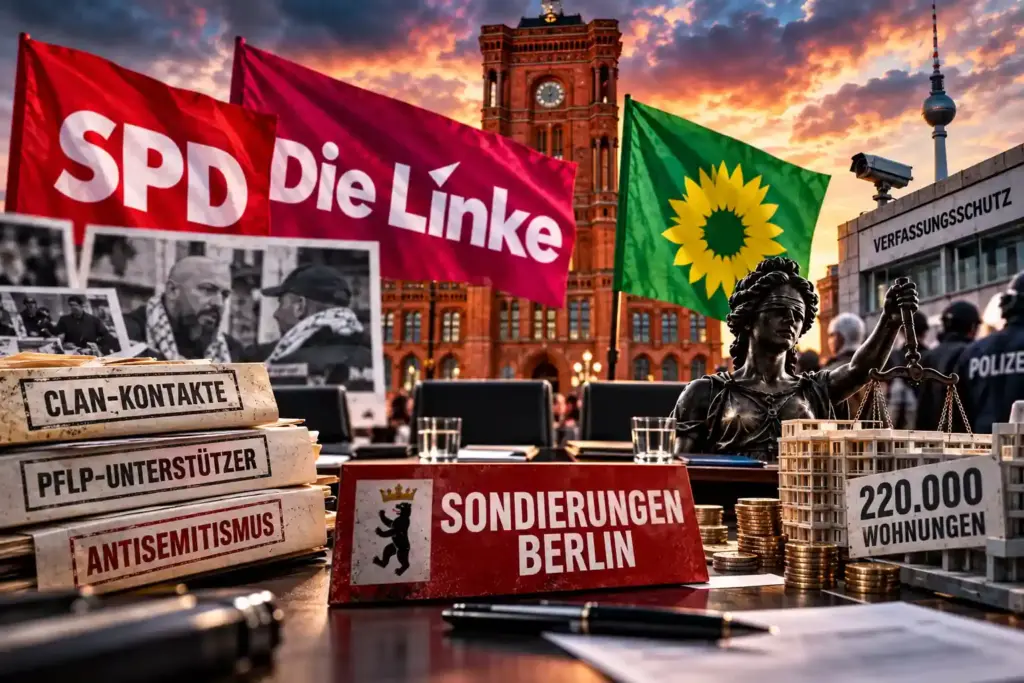
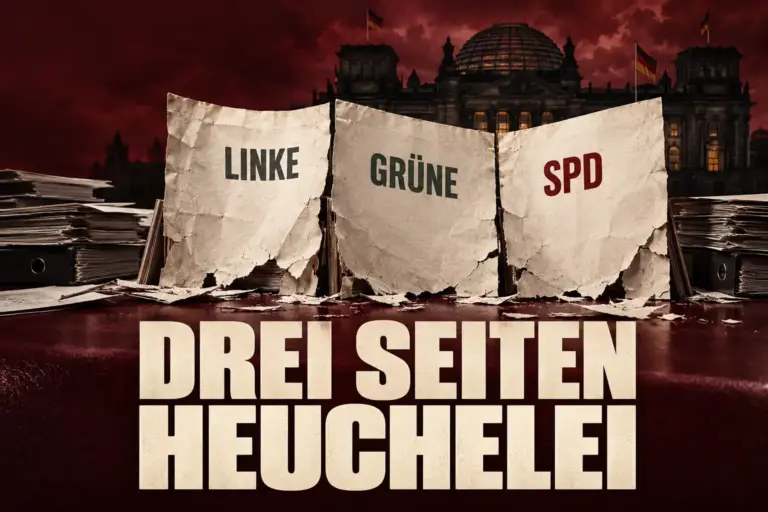
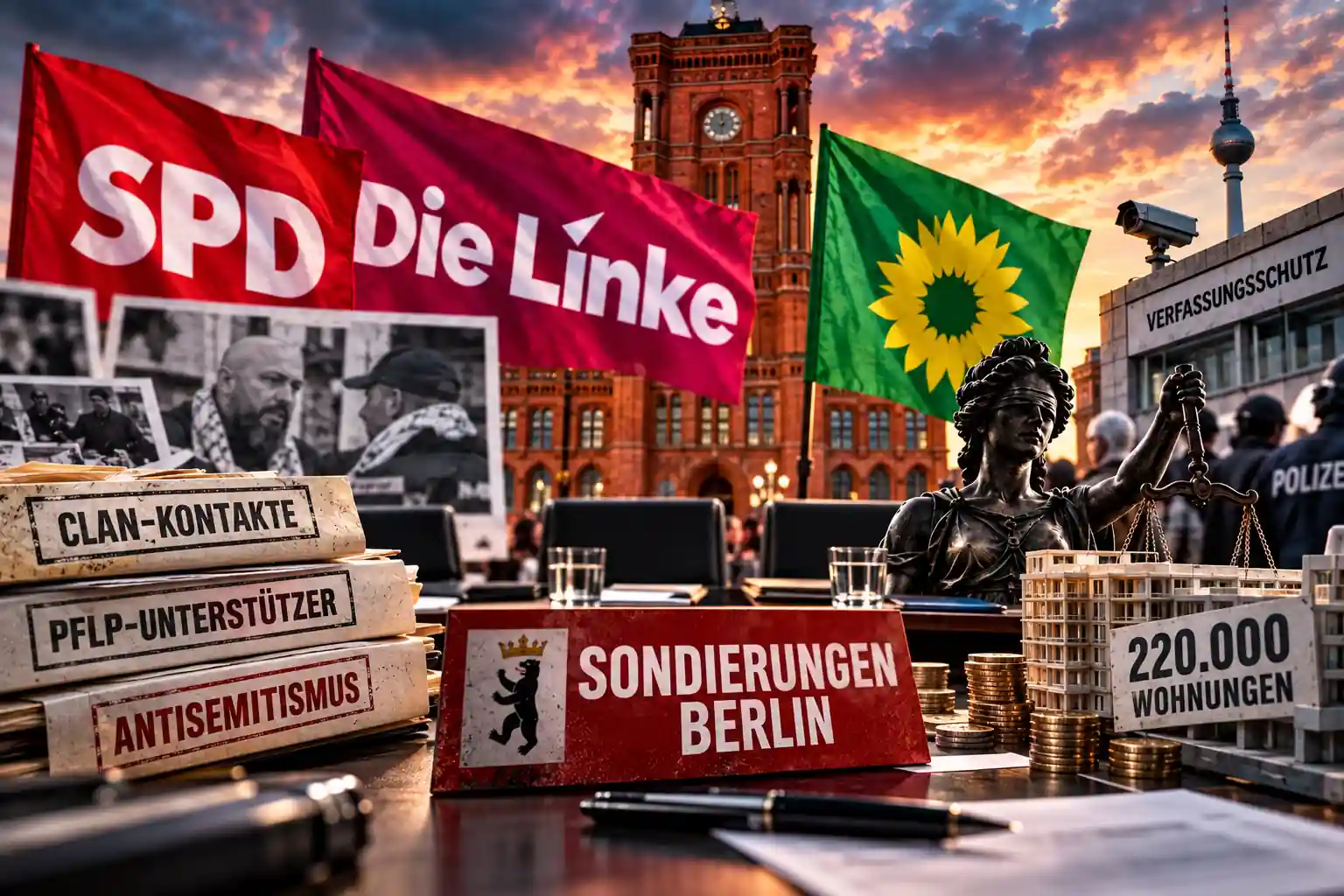
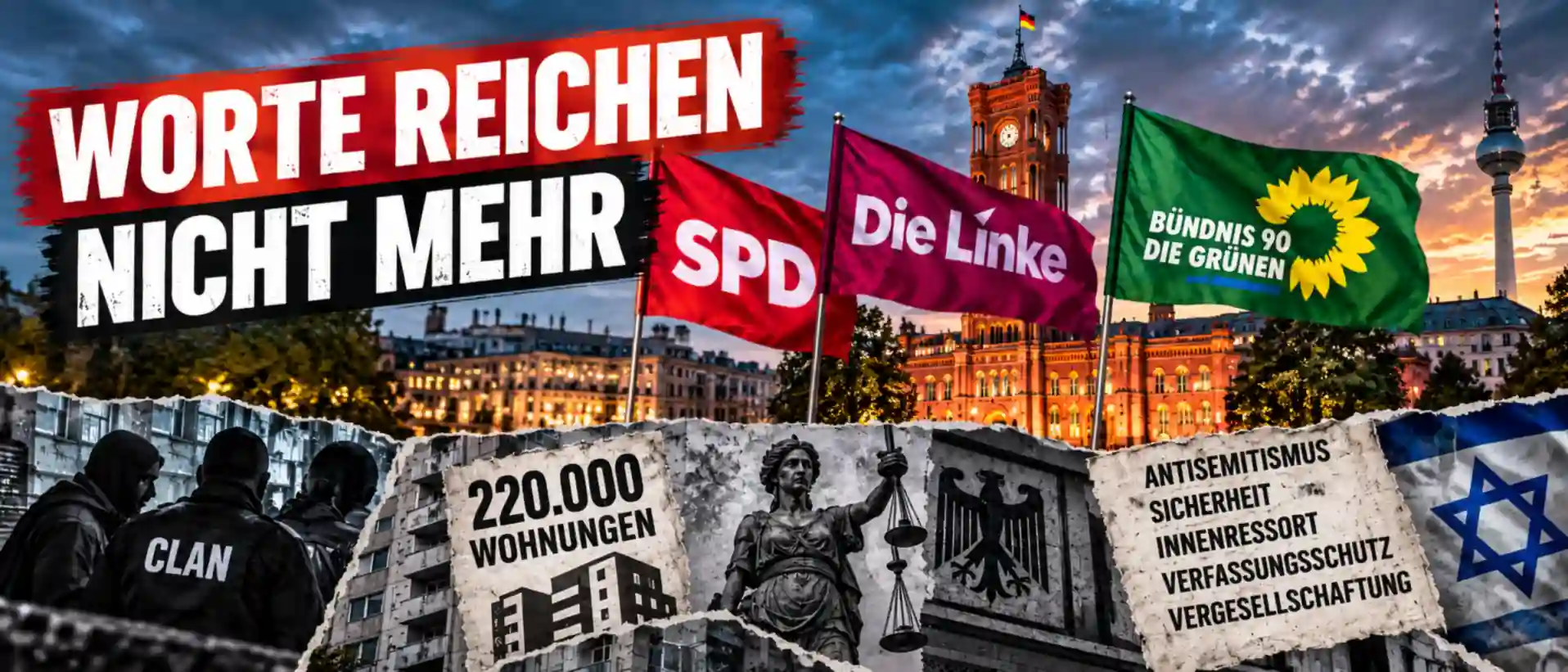
The SPD, Greens and Left want to discuss a joint government in Berlin. Mathematically, the numbers are sufficient. Politically, the exploratory talks are beginning with problems that cannot be resolved through friendly rounds of discussions: contacts in the clan milieu, the handling of PFLP supporters, allegations of antisemitism, disputes over the police and the Office for the Protection of the Constitution, as well as a housing policy involving billions and constitutional law. The decisive question is therefore not whether Red-Red-Green is possible. It is what all the declarations of principle are worth if they are to become concrete government policy.
On September 26, the Berlin SPD state executive also approved exploratory talks with the Greens and the Left. The Greens had previously given the go-ahead, while the Left approved entering the talks by a large majority at a special party conference. The three parties are therefore sitting at the table. That is still a long way from forming a coalition.
The balance of power has shifted significantly. According to the provisional official result from the state election authority the Left became the strongest party with 25.7 percent. The SPD fell to 12.1 percent, its worst result ever in Berlin. Left lead candidate Elif Eralp is laying claim to the Red City Hall.
Passende X-Beiträge
Aus dem SCHLAGSEITE X-ArchivExploratory talks with problems: Greens draw red lines on security
The first major conflict concerns domestic security. Green federal chairwoman Franziska Brantner told Der Spiegel that she could only “hardly imagine” the Left leading the interior or justice department as long as there are people within the party with links to organized crime or extremist forces such as the PFLP or Hamas.
This is not a formal veto right held by the Greens’ federal leadership. Politically, however, the message is unmistakable: Under the current circumstances, Brantner considers a Left-led interior or justice administration barely conceivable.
She is explicitly concerned with more than personnel. Brantner rejects demands from the Left to abolish Berlin’s Office for the Protection of the Constitution and, wherever possible, to replace or supplement police work with social work. A joint government would also have to affirm Israel’s right to exist and designate Hamas as a terrorist organization. In her account, anyone who glorifies or trivializes Hamas or questions Israel’s right to exist would have no place in such political cooperation.
This puts a fairly concrete benchmark on the table. The issue is no longer general statements against antisemitism. It concerns security authorities, personnel, party boundaries and the question of which political milieus a governing party is prepared to tolerate.
Koçak’s contacts in the clan milieu and with Ibrahim Ibrahim
This is particularly clear in the case of Left Bundestag member Ferat Koçak. Two incidents must be distinguished here.
The first concerns the clan milieu. Firas Remmo, a son of Issa Remmo, published a chat with Koçak, whose authenticity Koçak confirmed. In it, the member of parliament sent “greetings with respect” to Issa Remmo. Later, he sent Firas Remmo an excerpt from a Bundestag speech and asked him to circulate it and to encourage others to share it as well. Koçak subsequently explained, that he had initially not known whom he was communicating with. He himself described the later contact as a mistake and apologized.
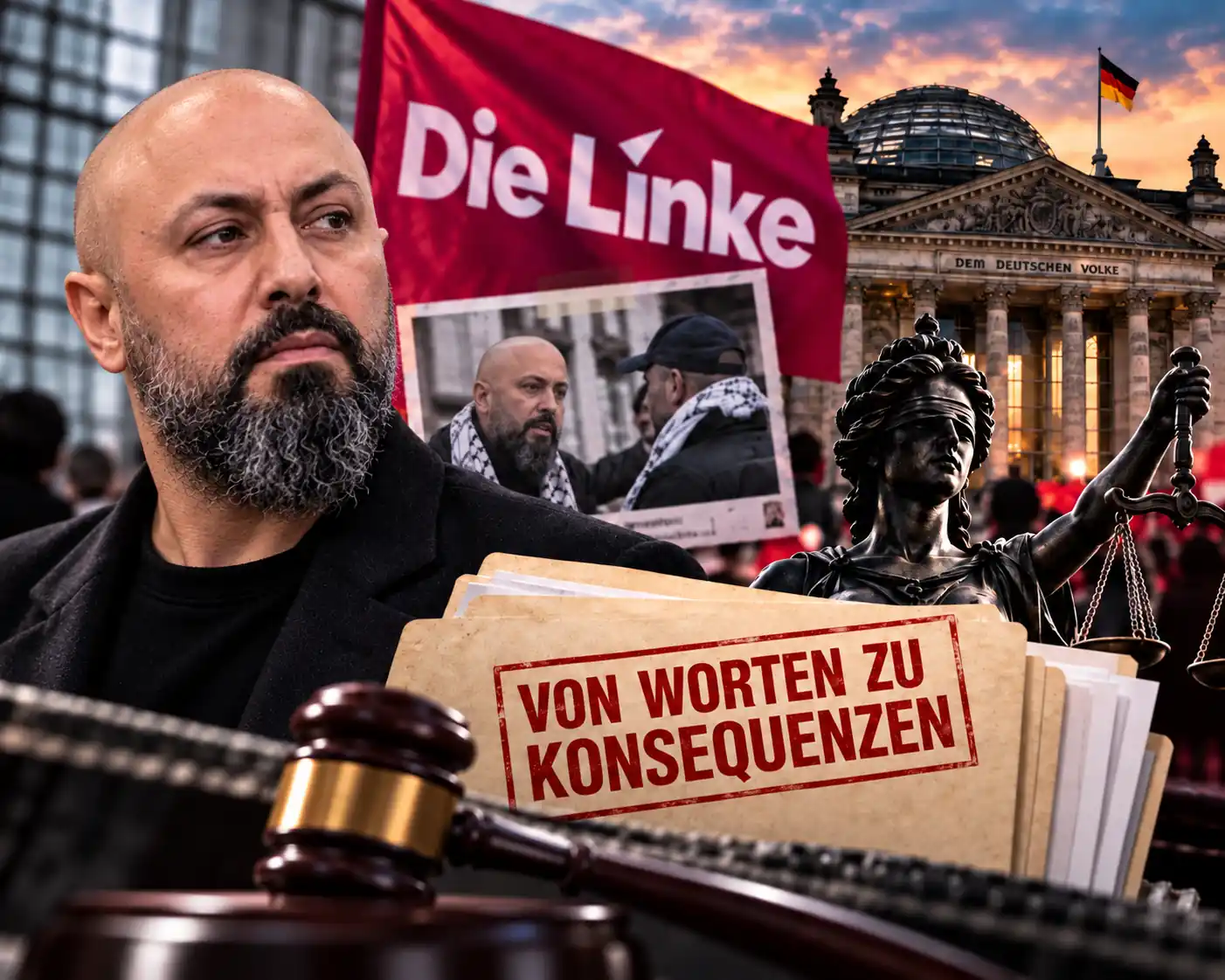
The second incident concerns Ibrahim Ibrahim. Koçak was photographed with him at the Left’s election-night party in Neukölln. Ibrahim has for years been attributed, among others by the organization Democ and in reporting citing the Berlin Office for the Protection of the Constitution, to the milieu surrounding the Popular Front for the Liberation of Palestine, PFLP. Even after the European Union Council’s most recent review of the Council of the European Union dated July 30, 2026 the PFLP remains on the European terrorist list.
The clan contact and the PFLP connection are two different matters. Conflating them would be sloppy. Taken together, however, they explain why the debate has long since gone beyond an unfortunate selfie.
Koçak has meanwhile temporarily withdrawn from public life and, until further notice, is not attending meetings of the Bundestag’s Interior Committee. Left co-chair of the parliamentary group Sören Pellmann said they first wanted to establish complete transparency. Further consequences would be decided afterward.
The word “temporarily” is crucial here. So far, what has been documented is Koçak’s temporary withdrawal, apologies and announced review. Permanent personnel or organizational consequences are not yet apparent in the decisions made public so far.
The Left admits mistakes while drawing a line at the same time
At the Left’s party conference, state chairwoman Kerstin Wolter spoke clearly about mistakes. Lines had been crossed, she said, and statements had frightened Jewish people. Eralp said she wanted to protect Jewish life and combat antisemitism. She described calls for violence against Israeli soldiers from a Left platform as unacceptable.
Anyone looking only at these statements might get the impression that the party had largely resolved the issue internally. On Deutschlandfunk, however, Wolter added an important qualification. Asked about a structural antisemitism problem within the Left, she initially replied that she did not see such a problem within her party. She then spoke of a structural antisemitism problem “in society as a whole.”
This is relevant to the exploratory talks. The SPD and Greens are not merely demanding recognition of a problem in society. They want to know what is happening within the Left itself. SPD state chairman Steffen Krach put it unusually clearly on rbb24: Eralp had taken a clear stand against antisemitism. “But these words are no longer enough,” Krach stressed. He was interested in what had actually happened within the Left following the events of the past days and weeks.
That is precisely where the gap lies that would have to be closed in these exploratory talks with problems: Statements on protecting Jewish life have been made. Apologies have been issued. Koçak has temporarily withdrawn. Whether this will lead to lasting rules, personnel consequences or clear distancing from specific actors and structures remains open.
Central Council and Israeli ambassador increase the pressure
This question is not being raised exclusively by the CDU, SPD or Greens. Josef Schuster, president of the Central Council of Jews in Germany, said after the election that no sufficient personnel or political consequences were discernible so far. He described the Left’s distancing as “lip service” and appealed to the SPD and Greens not to abandon their previous red lines.
The Berlin Left rejects the accusation that it is an antisemitic party. Wolter points to party resolutions on protecting Jewish life and to the fact that specific cases are being reviewed. Israel’s ambassador Ron Prosor also voiced sharp criticism. Speaking to the German Press Agency he said that, for Berlin’s Jewish community, a theoretical threat was becoming “a concrete and immediate existential danger.” The Berlin Left rejected Prosor’s accusations.
The exploratory talks with problems will therefore have to show what carries more weight: resolutions and public declarations of principle, or the practical handling of the incidents that triggered this debate.
Housing is not about 220,000 new apartments
Quite apart from the antisemitism and security debate, there is another conflict that no coalition rhetoric can make disappear. The Left wants to advance the socialization of large housing companies. Under its plans, around 220,000 apartments could be transferred into a non-profit structure. The Greens support implementing the 2021 referendum. SPD state chairman Krach has opposed it.
This would not create 220,000 new apartments. The issue is existing housing whose ownership structure is to be changed. Socialization under Article 15 of the Basic Law requires legislation and compensation. The expert commission appointed by the Berlin Senate Expert Commission considered socialization fundamentally possible under constitutional law, but left important questions concerning its specific design and proportionality dependent on the actual circumstances and the subsequent legislation.
This is therefore not merely a Left prestige project and an issue opposed by the SPD. It concerns billions, compensation questions and uncharted legal territory. This, too, could show how capable the parties actually are of compromise.
There is opposition within the SPD to the entire course
The fact that the Social Democrats are participating in exploratory talks with the Left at all is by no means undisputed within the SPD. Former leading Berlin politicians such as former Governing Mayors Michael Müller and Walter Momper, together with other former officeholders, jointly signed a resolution against talks with the Left.
They explicitly justified their opposition by citing the incidents surrounding antisemitism and clan contacts. The conflict is therefore not merely between three potential coalition partners. It runs right through the Berlin SPD.
Red-Red-Green is not a mathematical inevitability
There is also a point that is easily overlooked in the debate: another mathematical majority exists. The CDU, Greens and SPD could also govern together. Krach has already said that he would also speak with the CDU if it invited him to talks.
At the same time, he pointed out that these three parties had collectively lost votes in the election and that the Left was the clearer election winner. That does not change the parliamentary arithmetic, however. Red-Red-Green is a political option, not a mathematical necessity.
That is precisely why the upcoming exploratory talks carry more weight than an ordinary sounding-out of election platforms. The SPD and Greens must decide which of their announced conditions are genuinely prerequisites for cooperation. The Left must show how much of its own agenda it intends to implement in government and how it will deal with the incidents that had already raised doubts before the first meeting.

Forming a government is not about categorically accusing the Left of antisemitism. The facts available are too broad for that. The specific point of scrutiny is narrower and, at the same time, tougher: How does the party deal with documented incidents, problematic contacts and its own crossing of red lines? Public distancing has taken place. Final consequences remain open in several cases.
The red-red-green coalition can mathematically govern Berlin. Whether this becomes a resilient political majority will not be decided by the number of joint press releases. What matters are concrete answers to concrete conflicts: Who takes responsibility? Where are boundaries drawn? What follows apologies? And which demands survive the journey from the election manifesto to the cabinet table? Krach himself supplied the standard: words are no longer enough.
ℹ️ Factual basis and primary sources for the article 📑
▶️ tagesschau.de / rbb:
SPD wants to hold exploratory talks with the Left and Greens
Basis for the Berlin SPD’s decision and the status of the exploratory talks.
▶️ Berlin State Election Commissioner:
Preliminary result of the 2026 House of Representatives election
Official source for the election result.
▶️ Tagesspiegel:
Brantner’s conditions for a possible coalition
Documents Brantner’s statements on the interior and justice portfolios, the domestic intelligence service, the police, Hamas and Israel’s right to exist.
▶️ taz:
Chat with a member of the Remmo clan: Ferat Koçak apologizes
Documents the content and authenticity of the published chat with Firas Remmo, as well as Koçak’s statement.
▶️ Tagesspiegel:
Koçak temporarily suspends his posts
Documents his temporary withdrawal from the Interior Committee and public life.
▶️ European Union:
EU terror list following review of July 30, 2026
Current EU decision in which the PFLP continues to be listed.
▶️ Deutschlandfunk:
Berlin’s Left rejects accusations of antisemitism
Interview with Kerstin Wolter on dealing with mistakes and the question of a structural antisemitism problem.
▶️ Central Council of Jews in Germany:
Berlin elections 2026
Statement by President Josef Schuster on the incidents and the reactions of Berlin’s Left.
▶️ dpa / t-online:
Israel’s ambassador sees danger for Jews after Berlin election
Documents Ron Prosor’s warning of a “concrete and immediate existential threat” to the Jewish community, as well as the Berlin Left’s rejection of his allegations.
▶️ rbb24:
Krach on antisemitism and a possible CDU alternative
Documents Krach’s exact statement, “But these words are no longer enough,” as well as his willingness to hold talks with the CDU.
▶️ Tagesspiegel / dpa:
Veteran Berlin SPD politicians oppose talks with the Left
Documents the resolution by Michael Müller, Walter Momper and other former senior SPD figures.
▶️ Berlin State Expert Commission:
Socialization of large housing companies
Official documentation on the constitutional review of possible socialization.
🔎 Spotted an error, criticism or addition?
SCHLAGSEITE.eu stands for careful research and transparent corrections. Have you discovered a factual error, unclear wording or a broken link? Then send me your tip. If possible, please provide a verifiable source.