

00:00 / –:–
OPINION
“Israel, drop dead” is not, to me, a particularly rough form of foreign policy. Anyone who calls for the downfall of the Jewish state and is then told that this is indeed misanthropic but by no means antisemitic is not experiencing scholarly precision. They are experiencing a definition that fails at a crucial point.
That is precisely why it is worth talking about Wolfgang Benz, Stefanie Schüler-Springorum and the Center for Research on Antisemitism. Not because every criticism of Israel is antisemitic—it is not—but because their statements reveal a fundamental question: How narrowly must antisemitism be defined before open hatred of the Jewish state becomes nothing more than “criticism of Israel”?
“Israel, drop dead”—and still not antisemitism?
Wolfgang Benz shaped the TU Berlin’s Center for Research on Antisemitism for more than two decades. In the Tagesspiegel he says today of the Berlin Left: “The Left is not antisemitic.” He classifies problematic statements from parts of the party differently. In Neukölln in particular, he says, there are Palestinians and Muslims who use “nasty words” against Israel. That is not hostility toward Jews, he says, but political hostility toward the “occupying power Israel”.
The interviewers then present him with specific slogans: “Israel, drop dead,” “Israel, child murderer,” “Death to the IDF”. Are such slogans antisemitic? Benz says no—he calls them misanthropic, wrong, generalizing and defamatory, just not antisemitic.
This is precisely where my problem with this argument begins.

An Israeli government can be criticized. Military decisions can be criticized. Parties, ministers, settlement policy and every single political measure taken by Israel can be criticized. But anyone shouting “Israel, drop dead” is no longer criticizing a government. They are wishing for a state’s downfall—and that state is the only Jewish state in the world.
The definitional dispute is not an academic game
Of course, there is a scholarly conflict behind this dispute. The IHRA working definition explicitly states that antisemitism can also be directed against Israel as a Jewish collective. The Jerusalem Declaration on Antisemitism, or JDA for short, draws the line more narrowly when it comes to statements about Israel and does not, for example, consider anti-Zionism, calls for boycotts or double standards antisemitic in themselves. The 3-D test developed by Natan Sharansky, in turn, asks about demonization, double standards and delegitimization. The actual dispute, then, is not whether Israel may be criticized. It is when hostility toward Israel ceases to be political criticism and takes on antisemitic structures.
It is therefore interesting that both Wolfgang Benz and the current director of the ZfA, Stefanie Schüler-Springorum, are among the signatories of the Jerusalem Declaration Schüler-Springorum is listed as director of the Berlin center on the official list of signatories.
This does not prove that they share the same opinion in every individual case, but it explains why the line around antisemitism related to Israel is drawn differently here than under the IHRA or the 3-D test.

Passende X-Beiträge
Aus dem SCHLAGSEITE X-ArchivPolice protection is not an argument against the threat
I find Benz’s statements on the safety of Jews in Berlin even more problematic.
In the Tagesspiegel, he says that the safety of Berlin’s Jewish citizens is “not threatened by the Left”. In response to references to attacks on Jews, the bullying of Jewish children and Hamas symbols, he points out that Jews have been expressing fear for decades. It had been said before that they were ready to leave at any time; this was part of the “self-justification of Jewish life in Germany”.
Benz explicitly says that he believes Jews’ fear, but then comes an argument that I find difficult to follow: No other minority is protected by the police as well. He calls the police protection outside Jewish institutions “prophylactic” and asks, in effect, why so many Jews would rather live in Berlin than in Israel if Jewish life in Germany were truly so unsafe.
To me, this argument turns cause and effect on their head.
The fact that police have to stand outside synagogues, schools and Jewish institutions is not evidence that the threat is being overestimated; the police are there because there is a threat. The fact that this protection works and therefore an attack does not take place every day does not make the threat imaginary.
And the fact that Jews like living in Berlin proves nothing either. People can love their city and still be afraid. They can enjoy living in Germany and still hide their kippah. They can see this as their home and still consider whether they would be better off taking a different route during a demonstration. To treat this as a kind of contradiction strikes me as astonishingly detached from reality.
8,725 incidents are not a perceived threat
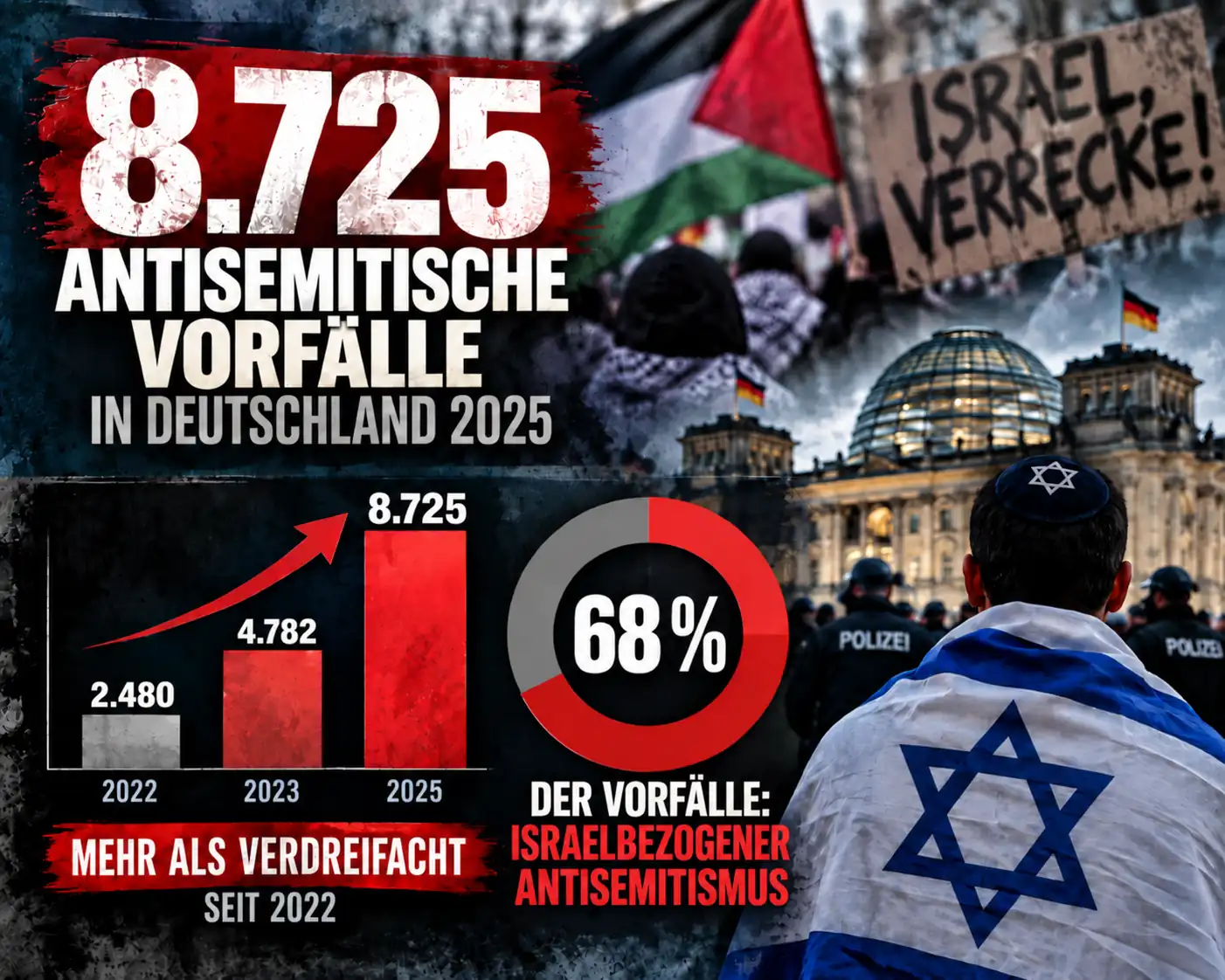
Especially since we are not talking exclusively about feelings. RIAS documented 8,725 antisemitic incidents nationwide in 2025. That is just under 24 a day. They included 257 threats, 178 attacks and four cases of extreme violence. In 68 percent of all documented incidents, RIAS recorded antisemitism related to Israel. Compared with 2022, the total number has more than tripled.
Of course, methods of recording and definitions can be debated; science must do so.
But given figures like these, I consider it quite bold to suggest that the actual problem lies primarily in an overly broad definition of antisemitism.
Benz does not represent the Center for Research on Antisemitism’s current position
For all the criticism, one distinction is necessary: Wolfgang Benz has not headed the Center for Research on Antisemitism for many years, and his current statements are not automatically the institute’s position.
That must not be omitted in a commentary simply because a stronger institutional accusation would be more convenient.
But that does not settle the matter, Stefanie Schüler-Springorum has been at the head of the ZfA since 2011, she is, like Benz, a signatory of the Jerusalem Declaration, and her current statements also show that the conflict does not rest solely on a retired scholar.
When “antisemitism exists everywhere” distracts from the specific allegation
Schüler-Springorum described the recent debate about antisemitism in the Berlin Left Party as “exaggerated”. Antisemitism exists in all parties, she said. She referred to the Left’s positions against antisemitism and warned against instrumentalizing the issue in connection with the formation of Berlin’s government.
Here, too, my problem is not that differentiation is being demanded; differentiation is necessary. But pointing out that antisemitism exists everywhere does not answer a single specific allegation.
When particular slogans are uttered at events, when people maintain certain contacts or when party officials respond to specific incidents, that is precisely what must be discussed. The statement “Antisemitism exists elsewhere too” may be correct and still miss the point.
A party can adopt ten resolutions against antisemitism and still have problems in parts of its structures. Paper is patient, after all; what matters is what happens when the specific case comes knocking.
Why antisemitism related to Israel is harder to recognize
That is why the decisive point, to me, lies elsewhere. Antisemitism is recognized remarkably easily as long as classic stereotypes appear. Conspiracy narratives, hatred of Jews, glorification of Nazism—no one needs to spend long explaining why this is antisemitic.
As soon as the same mechanisms are directed at Israel, a semantic obstacle course suddenly begins. Then people ask whether Jews are really meant. Whether Israel does not also have Arab citizens. Whether this is not merely anti-Zionism. Whether the slogan is not meant politically rather than ethnically.
Of course, such questions must be asked. But they must not become a method for dismantling every connection to antisemitism until nothing remains.
The JDA also explains by no means that every hostility toward Israel is automatically unproblematic. Classic anti-Jewish stereotypes transferred to Israel, or holding Jews collectively responsible for Israeli policy, are considered antisemitic there as well.
The precise boundary is therefore disputed; the existence of antisemitism related to Israel is not.
With “Israel, drop dead,” I have reached my limit
And that is why I return to the sentence with which it all began.
“Israel, drop dead.” One can scientifically dissect this sentence into its individual parts. One can point out that it says “Israel” and not “Jews”; one can explain that political hostility toward a state is theoretically something different from hostility toward a people.
All true, but in the end there is still a sentence wishing for the downfall of the Jewish state; to me, that is where the line is crossed.
Not because Israel should not be criticized, but because there is a difference between “This government is acting wrongly” and “This state should drop dead”—a difference that should not be defined away.
The Center for Research on Antisemitism must look more closely
The Center for Research on Antisemitism has an important task, which is precisely why the debate about its standards is legitimate.
If the former director and the current director of one of Germany’s most important antisemitism institutes—the Center for Research on Antisemitism—both advocate an approach that draws the line regarding Israel considerably more narrowly than other established models, it must be permissible to debate that.
To me, the problem begins where scholarly differentiation means that an extermination slogan against the Jewish state may be considered misanthropic and abhorrent, but is explicitly not considered antisemitic. Research should sharpen concepts. It should not draw them so narrowly that antisemitism ultimately disappears simply because the word “Jew” has been replaced with “Israel”.
ℹ️ Factual basis and primary sources for the commentary 📑
▶️ Tagesspiegel, 25 September 2026:
Historian Wolfgang Benz in conversation: “The Left is not antisemitic”
Interview by Robert Ide and Adrian Schulz with Wolfgang Benz. Contains Benz’s statements on the Berlin Left, “Israel, drop dead,” the safety of Jewish Berliners, the “self-justification of Jewish life” and police protection.
▶️ Jüdische Allgemeine, 25 September 2026:
Wolfgang Benz, Stefanie Schüler-Springorum and Germany’s Center for Antisemitism Denial
Commentary by Philipp Peyman Engel on Wolfgang Benz, Stefanie Schüler-Springorum and the Center for Research on Antisemitism.
▶️ Federal Association of RIAS, 17 June 2026:
Antisemitic incidents in Germany in 2025
8,725 incidents were documented, including 178 attacks and 257 threats. 68 percent of all documented incidents were classified as antisemitism related to Israel.
▶️ rbb24 / German Press Agency, September 22, 2026:
Antisemitism debate: Left Party considers expelling pro-Palestinian activist
Statements by Stefanie Schüler-Springorum on the antisemitism debate within Berlin’s Left Party.
▶️ International Holocaust Remembrance Alliance:
IHRA working definition of antisemitism
Official German version of the working definition, with examples of manifestations of antisemitism.
▶️ Jerusalem Declaration on Antisemitism:
Jerusalem Declaration on Antisemitism and official list of signatories
The official JDA website contains the declaration, guidelines and signatories, including Wolfgang Benz and Stefanie Schüler-Springorum.
▶️ Federal Agency for Civic Education:
Three-D Test
Explanation of the 3-D test, using the criteria of demonization, double standards and delegitimization.
▶️ Technical University of Berlin:
Wolfgang Benz and
Stefanie Schüler-Springorum
Information on Wolfgang Benz and Stefanie Schüler-Springorum, as well as on the leadership of the Center for Research on Antisemitism.
🔎 Spotted an error, criticism or addition?
SCHLAGSEITE.eu stands for careful research and transparent corrections. Have you discovered a factual error, unclear wording or a broken link? Then send me your tip. If possible, please provide a verifiable source.